
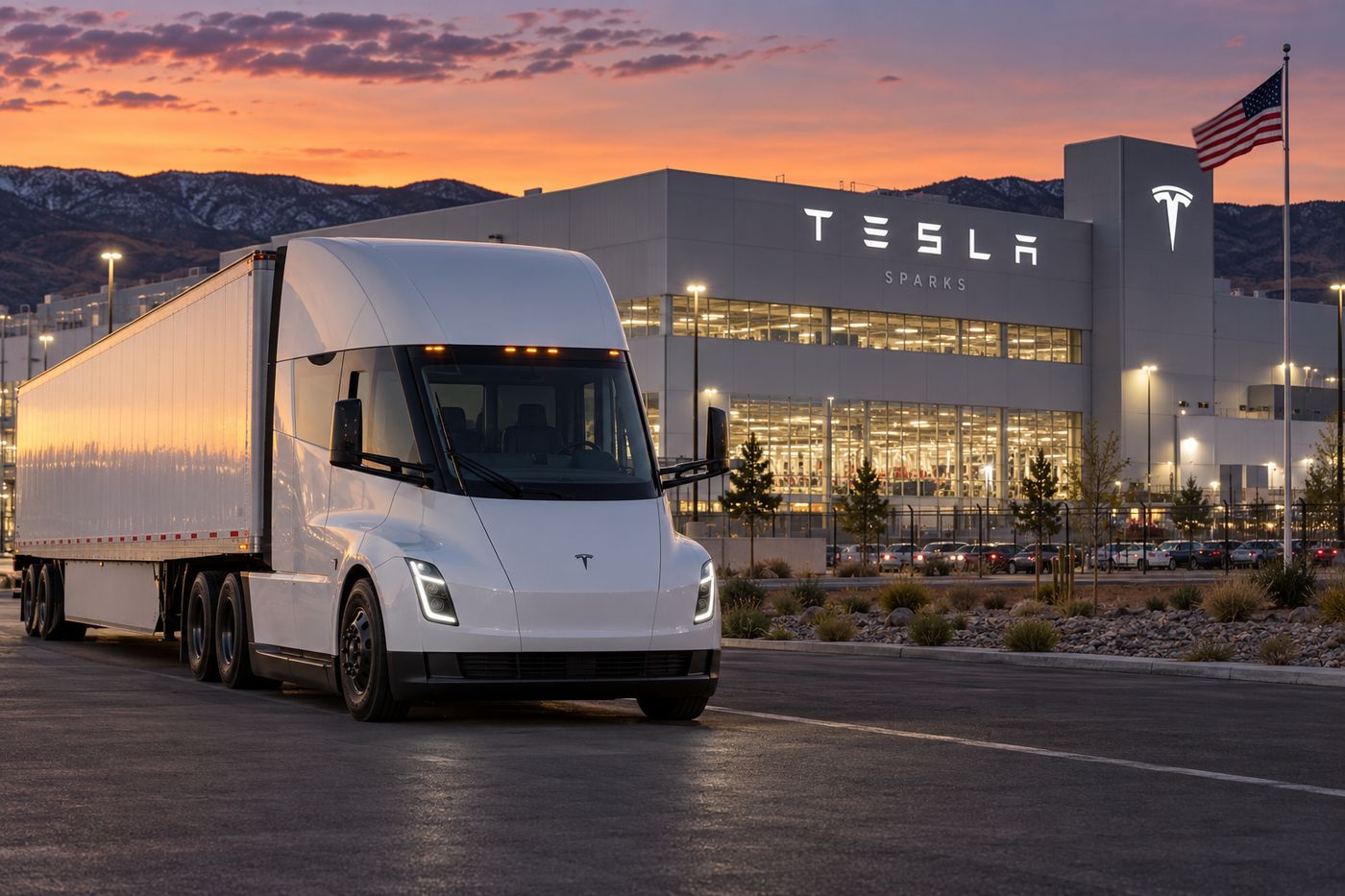
Tesla began delivering its Semi electric trucks to a first group of commercial customers this week at an event at its dedicated Semi factory in Sparks, Nevada — formally inaugurating volume production of a vehicle Elon Musk first unveiled in 2017 with a 2019 production target, making the gap between announcement and delivery approximately nine years and approximately six years longer than initially promised.
The deliveries represent the transition from limited pilot programs — Tesla delivered a small number of Semis to PepsiCo in late 2022 for real-world testing — to volume commercial production from a factory designed to produce 50,000 trucks per year. At the Sparks event, trucks branded for at least nine customers were displayed outside the plant, among them PepsiCo, DHL, US Foods, ArcBest, Einride, IMC Logistics, WattEV, and OK Produce. PepsiCo, the earliest real-world operator, now runs dozens of Semis in daily regional service. DHL received its first delivery in December 2025. The Semi is available in two configurations: a long-range variant rated for 500 miles per charge on a fully loaded 80,000-pound vehicle — a figure Tesla's engineering director Dan Priestley called real-world validated — and a standard version rated for 325 miles. Reports from earlier in 2026 put the long-range price at approximately $290,000, roughly double the $150,000-$180,000 Musk originally advertised in 2017, though still meaningfully cheaper than competing European electric trucks that can exceed $450,000.
"That's 500 real-world miles. Our customers have validated it. I'd recommend placing more orders if you haven't already." — Tesla Semi engineering director Dan Priestley and Elon Musk (via recorded video), at the Sparks Nevada delivery event
Musk himself did not attend the delivery event — he was at President Trump's state dinner for Chinese President Xi Jinping. The Semi is entering the commercial market at a moment when diesel prices in the United States have reached record levels, creating a cost argument for electric freight that was less compelling when fuel was cheaper. A coalition of major cargo-owning shippers including Microsoft and PepsiCo this week selected Tesla to help supply 2,500 trucks for zero-emission freight in California — the largest single-event demand signal the Semi has received. Einride's 500-truck order in August was, at the time of its placement, the largest commitment ever made for the vehicle. Outside analyst estimates put 2026 deliveries at 5,000 to 15,000 units — well below the factory's 50,000-unit annual capacity, but a meaningful start to scaling production.
The Tesla Semi story is a study in the gap between Musk's timelines and reality — a gap that has become so well documented that Tesla investors have essentially priced it in as a feature rather than a bug of the company's development process. The Semi was promised for 2019. The first limited deliveries happened in 2022. Volume production began in April 2026. The factory that is now supposed to produce 50,000 units per year has not yet demonstrated anything close to that rate. The charging infrastructure for long-haul trucking remains a genuine operational challenge that Tesla has not fully solved. These are the caveats. The other side of the ledger is that the truck is real, it works, customers who have driven it in real service report 500-mile range as accurate, and the freight economics at current diesel prices are compelling enough that order books are filling.
The Tesla Semi factory in Sparks, Nevada, is located adjacent to Tesla's Gigafactory battery production campus. The facility was purpose-built for Semi production and represents a significant capital commitment to the commercial trucking market. The Class 8 semi-trailer truck market in the United States moves approximately 11 billion tons of freight annually. Diesel fuel currently costs roughly $4.80 per gallon nationally — near record highs — making the economics of electric freight more favorable than at any previous point in the Tesla Semi's development timeline.
The Tesla Semi is finally real — nine years, multiple revised timelines, and one bankruptcy-adjacent period later. That is a longer road than promised and a more expensive destination than advertised. It is also, by any honest assessment, an impressive piece of engineering that can haul 80,000 pounds 500 miles on a single charge at a total cost of operation that is increasingly competitive with diesel. Whether Tesla can hit 50,000 units a year in Sparks is the next question. Given the company's track record on production timelines, the safe assumption is that it will take longer than currently projected. The safe assumption has been correct about Tesla manufacturing targets every previous time it has been applied — and the safe assumption has also repeatedly underestimated what the company eventually delivers.