
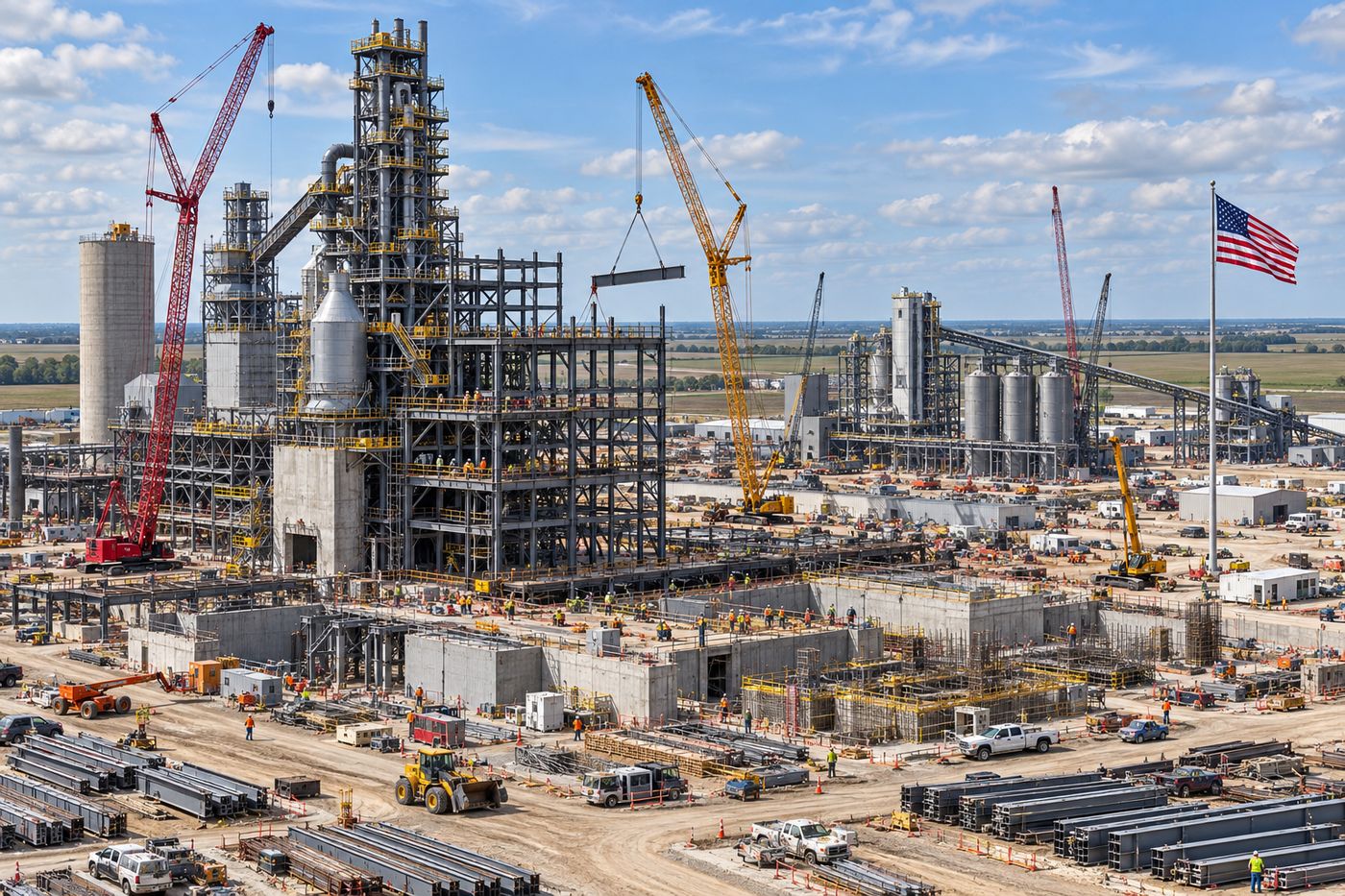
President Trump announced Monday at an Oval Office event that Mesabi Metallics will build the largest steel plant in American history in Iowa — a $15 billion investment that the White House describes as the first new "mega-steel" facility in the United States since the 1960s, capable of producing up to 10 million tons of steel annually once fully operational and expected to create more than 1,750 permanent jobs in the state.
The Iowa plant is the downstream component of a broader Mesabi investment that includes a $2.5 billion iron ore mine already under construction in Minnesota — the two projects together representing nearly $18 billion in total investment, according to the White House. The first phase of the Iowa plant will begin at an initial production capacity of 7.5 million tons per year, with the potential to expand to 10 million tons. First steel production is targeted for 2030. Unlike the smaller electric arc furnace plants that have characterized most recent American steel investment, the Iowa project will be a large-scale integrated steel facility capable of supporting defense sector requirements for high-grade steel — a designation the White House said adds a national security dimension to the project that goes beyond economic development. The White House estimates the combined Minnesota-Iowa investment will generate approximately $95 billion in total economic activity during construction and the plant's first decade of operation.
"After decades of decline, this President is restoring America's industrial competitiveness and securing trillions of dollars in new investment." — White House official, on the Mesabi Metallics Iowa steel plant announcement
Trump's 50% tariffs on steel and aluminum imports — which the administration imposed last year — are the explicit policy driver behind the investment. By making imported steel significantly more expensive, the tariffs gave domestic producers the pricing room to justify the capital expenditure required for a facility at this scale. The American Iron and Steel Institute's CEO Kevin Dempsey attributed the broader industry resurgence directly to the tariff policy: "We've seen imports decline substantially and, more importantly, the share of the U.S. market taken by imports has declined. That's allowed U.S. steelmakers to increase production, increase sales and invest upwards of $40 billion in upgraded plants and equipment." The data supports that framing. Domestic producers shipped nearly 55.75 million tons during the first seven months of 2026, with mills operating at 79% of production capacity — up from 77% in July 2025. That is a meaningful improvement in an industry that spent decades watching capacity erode in the face of cheaper foreign competition.
The announcement comes at a politically significant moment — Iowa has a competitive U.S. Senate race and four contested congressional districts ahead of November 3, and the Trump administration has been aggressive about staging manufacturing investment announcements in battleground states during the final stretch of the midterm campaign. The project's underlying economics are real and its scale is genuinely historic. The political timing of the announcement is equally real, and voters are capable of holding both facts simultaneously. The Mesabi Metallics project traces back nearly two decades, including a 2016 Chapter 11 bankruptcy filing by the predecessor company Essar Steel Minnesota. Its emergence from that history into a $15 billion announcement represents the kind of industrial resurrection the tariff policy was designed to produce.
Mesabi Metallics is owned by Essar Global, an Indian conglomerate. The Minnesota iron ore mining operation has begun preliminary work and is targeting initial direct-reduced iron pellet production in the fourth quarter of 2026, followed by an eight-to-twelve month ramp-up to commercial volumes. Federal data shows iron and steel prices rose 10.4% between April 2025 and April 2026, reflecting both the tariff impact and increased domestic production. The White House has not disclosed the terms of any federal incentives or financing arrangements related to the Iowa project.
The largest steel plant in American history coming to Iowa because tariffs made the economics viable is exactly the outcome the administration said it was trying to produce when it implemented those tariffs. Critics who said tariffs would only raise prices for steel consumers were right that costs went up — iron and steel prices rose more than 10% in the past year. But they underestimated the investment response those higher prices would incentivize in domestic production. A $15 billion mega-steel facility that produces 10 million tons a year and creates 1,750 permanent jobs is not nothing. It is, in fact, the kind of manufacturing investment that American industrial policy has been trying and failing to generate for sixty years.