
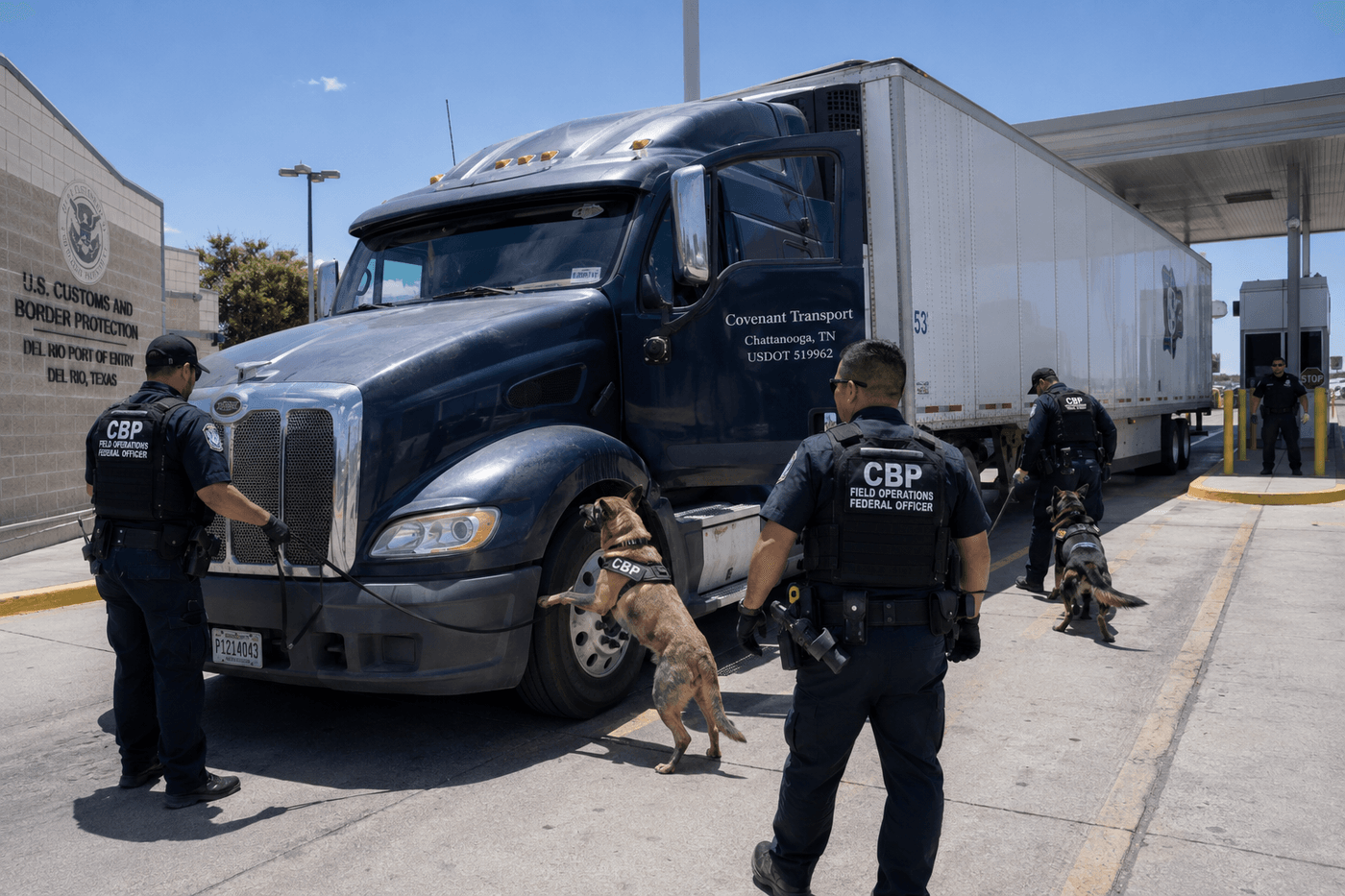
Customs and Border Protection officers at the Pharr Port of Entry in Texas intercepted nearly 1,200 pounds of cocaine concealed inside a commercial cabbage shipment Monday, seizing 477 individually wrapped packages with a combined street value of nearly $10.8 million in one of the largest single drug busts at the Texas border so far this year.
The discovery came after a CBP canine team flagged the inbound commercial tractor-trailer and officers followed up with a nonintrusive imaging scan that revealed an anomalous hidden load inside the trailer. A physical search confirmed what the scan suggested: 477 packages of cocaine carefully packed among the legitimate cabbage cargo, totaling 1,173 pounds of the drug. The Pharr Port of Entry sits at the southernmost tip of Texas, directly across the Rio Grande from the Mexican state of Tamaulipas — one of the primary cross-border corridors for cartel-controlled commercial smuggling operations.
"This interception is a powerful reminder that our CBP officers are on duty 24/7, employing every resource to detect and deter those who attempt to exploit our borders." — Port Director Carlos Rodriguez, Hidalgo Port of Entry
The bust illustrates both the effectiveness of current border security investments and the persistence of the smuggling threat those investments are designed to counter. Since the end of 2024, illegal border crossings have plummeted by roughly 90% — from more than 144,000 encounters in December 2024 to just 13,500 in May 2026 — a result the Trump administration attributes to aggressive enforcement, expanded deportation operations, and the deterrent effect of the administration's border security posture. But as human smuggling and low-level border crossings have cratered, CBP officials note that organized criminal enterprises have shifted their focus more heavily toward commercial smuggling operations, using legitimate trade flows as cover for drug trafficking at industrial scale.
Congress has responded with unprecedented investment. The One Big Beautiful Bill included $64 billion for CBP, and a subsequent DHS funding measure added another $26 billion — a substantial portion earmarked specifically for staffing. CBP announced earlier this year that it had reached 21,471 officers, the most in the agency's 102-year history. The combination of record staffing, advanced imaging technology, and highly trained canine units is producing results — including Monday's $10.8 million seizure — but cartel logistics operations remain sophisticated and relentless in probing for vulnerabilities in the commercial inspection system.
The Pharr-Reynosa International Bridge is one of the busiest commercial ports of entry on the southern border, processing thousands of commercial truck crossings daily. The sheer volume of legitimate trade — including fresh produce, automotive parts, and manufactured goods — creates inherent inspection challenges that cartels systematically attempt to exploit. CBP's nonintrusive imaging technology, combined with trained canines, has become the primary first line of detection for commercial vehicle smuggling operations.
Monday's seizure is a reminder that border security is not a problem that gets solved — it is a competition that must be won continuously, at every port of entry, every day. The cartels will keep adapting. The cabbage shipment will be replaced by something else. What matters is that CBP keeps pace, keeps staffing up, and keeps deploying the tools that caught 1,173 pounds of cocaine before it reached American streets. That is exactly what Congress funded and exactly what the officers at Pharr delivered on Monday.