
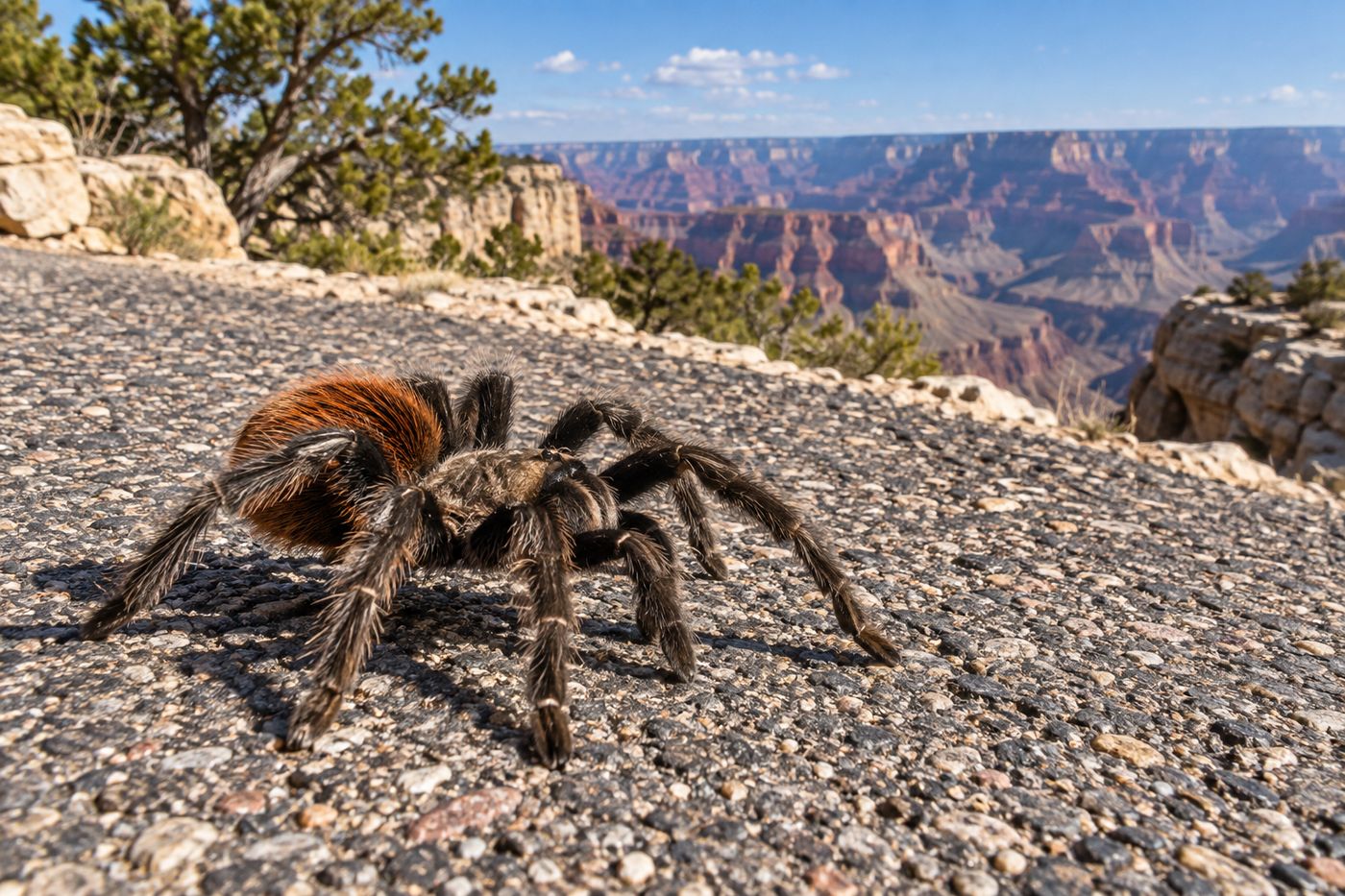
September and October mark tarantula season at Grand Canyon National Park — the annual window when male Grand Canyon black tarantulas emerge from their underground burrows and roam the park's landscape in search of a mate, crossing roads, trails, and viewpoints in a way that surprises unprepared visitors and delights the ones who know to watch for them.
The Grand Canyon black tarantula is a distinctive creature: it can reach four inches from leg tip to leg tip, is covered in thick dark hair, and has a reddish-orange abdomen that makes it immediately recognizable from a comfortable viewing distance. These spiders live throughout Grand Canyon National Park in underground burrows that they construct and maintain for most of their lives — the females spending their adult years largely underground, while the males emerge each fall in what amounts to a seasonal migration driven entirely by the biological imperative to find a mate. Tarantulas living inside the canyon tend to grow slightly larger than those found along the rim, according to the National Park Service, due to differences in prey availability and microclimate. The spiders are not rare or unusual at the canyon — they are permanent residents — but the fall emergence makes them dramatically more visible to visitors who would otherwise never encounter one.
"Grand Canyon black tarantulas are not aggressive by nature and would rather retreat than confront a human. While tarantulas may be out and about, visitors don't need to fear a surprise attack." — National Park Service, Grand Canyon
The appropriate response to encountering a tarantula on a Grand Canyon trail is not to panic and certainly not to pick it up. The NPS is explicit on both points. These spiders are generally not dangerous and reserve biting for situations where they feel genuinely threatened — a bite, while painful and typically compared to a wasp sting, is not medically serious for most people. But the spiders are also fragile: their large bodies make them vulnerable to falls, and an accidental step or a dropped spider can kill them. The park recommends admiring them from a safe distance — a philosophy that serves both the visitor's comfort and the spider's continued existence. The males' seasonal wandering ends either in successful mating — after which the female typically consumes the male — or in death by other means. The females, for their part, may live 20 to 25 years in their burrows, emerging mainly to capture prey at night.
The timing of tarantula season coincides with the Grand Canyon's most beautiful fall hiking weather — cooler temperatures, lower humidity, and the late-season light that photographers specifically seek out for rim and inner-canyon shots. Visitors already making the trip for fall foliage or the annual reduction in summer crowds now have an additional natural spectacle to watch for. Tarantula sightings have been appearing across social media platforms as park visitors encounter the spiders on paved roads, dirt paths, and the main rim trail — photos that tend to generate strong reactions from people who have not previously considered that a four-inch dark-haired spider with a reddish-orange abdomen might be crossing the path between them and the canyon overlook.
Grand Canyon National Park receives approximately six million visitors annually, making it one of the most visited national parks in the United States. The park's wildlife includes California condors, mule deer, bighorn sheep, mountain lions, elk, and more than 70 species of mammals alongside the park's many reptile and invertebrate residents. The Grand Canyon black tarantula (Aphonopelma marxi) is endemic to the canyon and surrounding plateau country. Male tarantulas typically live only a few years after reaching sexual maturity, while females of most North American tarantula species can reach 20 to 25 years of age in the wild.
The Grand Canyon black tarantula is, by any honest assessment, an impressive animal — patient, ancient by insect standards, perfectly adapted to one of the most demanding environments on the continent, and harmless to everyone who gives it the basic courtesy of not stepping on it. The fall emergence is one of those quietly remarkable natural events that national parks exist to offer — not a spectacle engineered for visitors but a real biological process that plays out on its own schedule, indifferent to human presence, viewable by anyone willing to pay attention to the ground. Grand Canyon has the canyon. In fall, it also has the tarantulas. Both are worth the trip.