
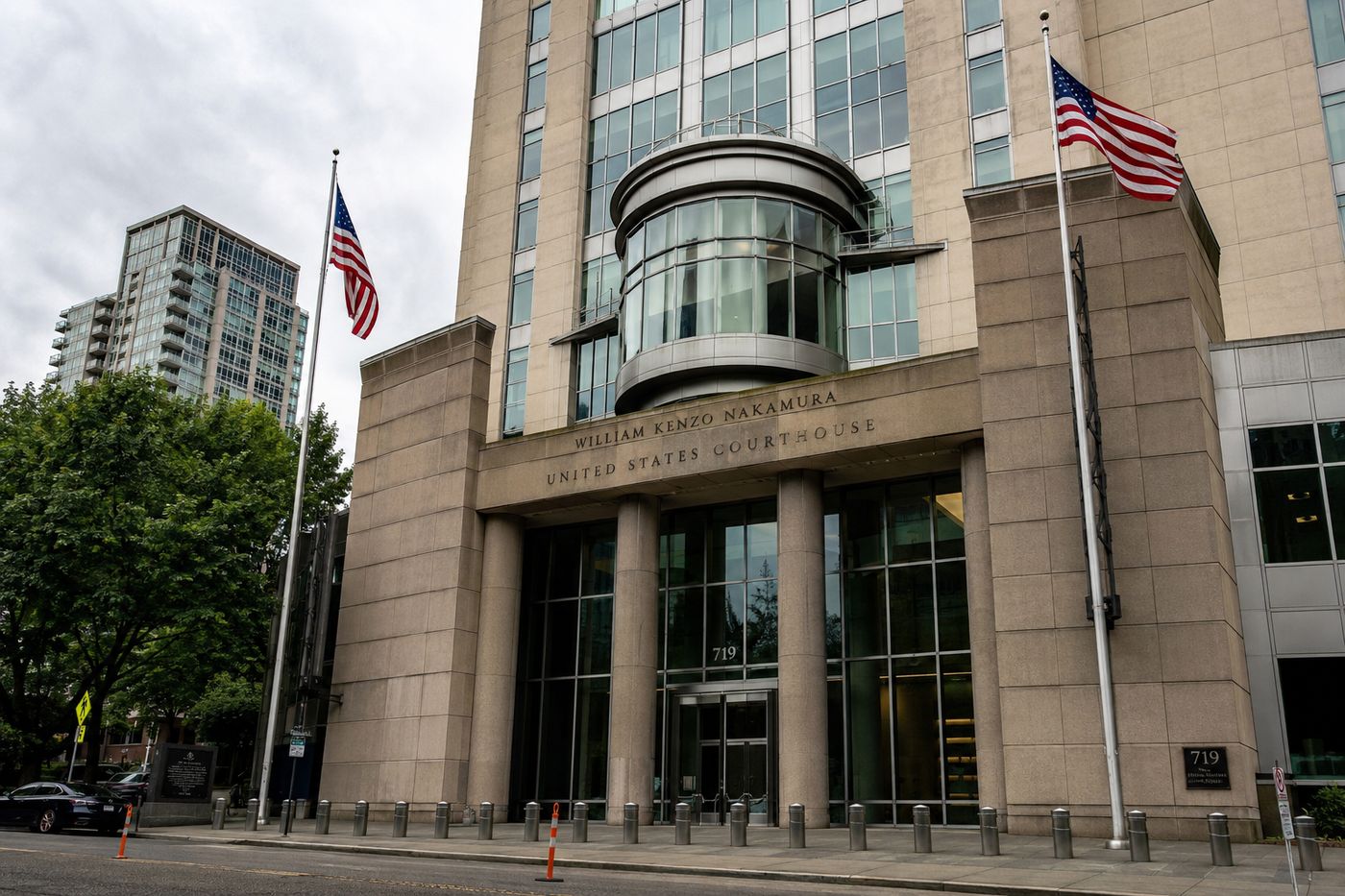
President Trump fired the newly sworn-in U.S. attorney for Seattle's Western District of Washington just 54 minutes after a panel of 17 federal judges — appointed by five presidents across both parties — unanimously installed Roger Rogoff in the role without consulting the White House, escalating a growing constitutional standoff over who controls U.S. attorney appointments when the Senate confirmation process stalls.
Rogoff, a former King County Superior Court judge with more than two decades of state and federal prosecutorial experience, was sworn in before 8 a.m. Wednesday at the federal courthouse in downtown Seattle. He then walked to the U.S. Attorney's Office and asked to meet with Charles Neil Floyd — the Trump administration's preferred choice for the job whose 120-day interim appointment had expired in February. While Rogoff waited in the lobby, an email arrived from the Trump administration informing him he had been fired. Acting Attorney General Todd Blanche announced the termination simultaneously on X: "District court judges can appoint a temporary U.S. Attorney, and POTUS can fire them. Roger Rogoff has been fired by the President." Rogoff's legal team is expected to sue the Justice Department, setting up what could become a landmark separation of powers case.
"District court judges can appoint a temporary U.S. Attorney, and POTUS can fire them. WDWA judges abandoned the time-honored process of consultation with the administration so that the selected U.S. Attorney is qualified to serve in the administration." — Acting AG Todd Blanche
The underlying dispute is straightforward in its constitutional stakes. Under federal law, U.S. attorneys are nominated by the president and confirmed by the Senate. If a vacancy is not filled within 120 days through the interim appointment process, federal district judges may appoint someone to fill it until the president's nominee is confirmed. That is precisely the mechanism the Western District judges invoked — Floyd's interim term had lapsed in February and the administration had not sent a permanent nomination to the Senate, instead relabeling Floyd as first assistant U.S. attorney to keep him in place. A federal appeals court had already expressed doubt that the move was legal. The judges, acting under their statutory authority, named Rogoff unanimously. The administration, asserting its Article II removal power, fired him within the hour.
The Seattle firing is not the first of its kind. The Trump administration previously fired court-appointed U.S. attorneys in the Northern District of New York and Virginia under similar circumstances, with Blanche asserting each time that the president's removal power supersedes the judiciary's appointment authority once a temporary prosecutor is installed. The constitutional question — whether a court-appointed interim U.S. attorney is subject to at-will presidential removal — has not been definitively resolved by the Supreme Court, and Rogoff's anticipated lawsuit may force that resolution.
Roger Rogoff spent 20 years as a state prosecutor, six years as a federal prosecutor, and served as a King County Superior Court judge before becoming the first director of Washington State's Office of Independent Investigations, which investigates police use-of-force incidents. He told reporters he knew the administration might fire him immediately but chose to accept the appointment anyway, calling U.S. attorney "the best job there is." Sen. Patty Murray called Rogoff "eminently qualified" and accused the administration of wanting to "install cronies to carry out a corrupt political agenda."
The Trump administration's position is constitutionally defensible and practically essential: the president's law enforcement authority cannot be functionally nullified by federal judges unilaterally installing prosecutors the White House did not choose and will not supervise. The solution is for the Senate to process U.S. attorney nominations in a timely fashion — but in the interim, the administration is correct that the removal power belongs to the executive, not the judiciary. The courts can fill a vacancy; they cannot compel the president to keep whoever they pick.