
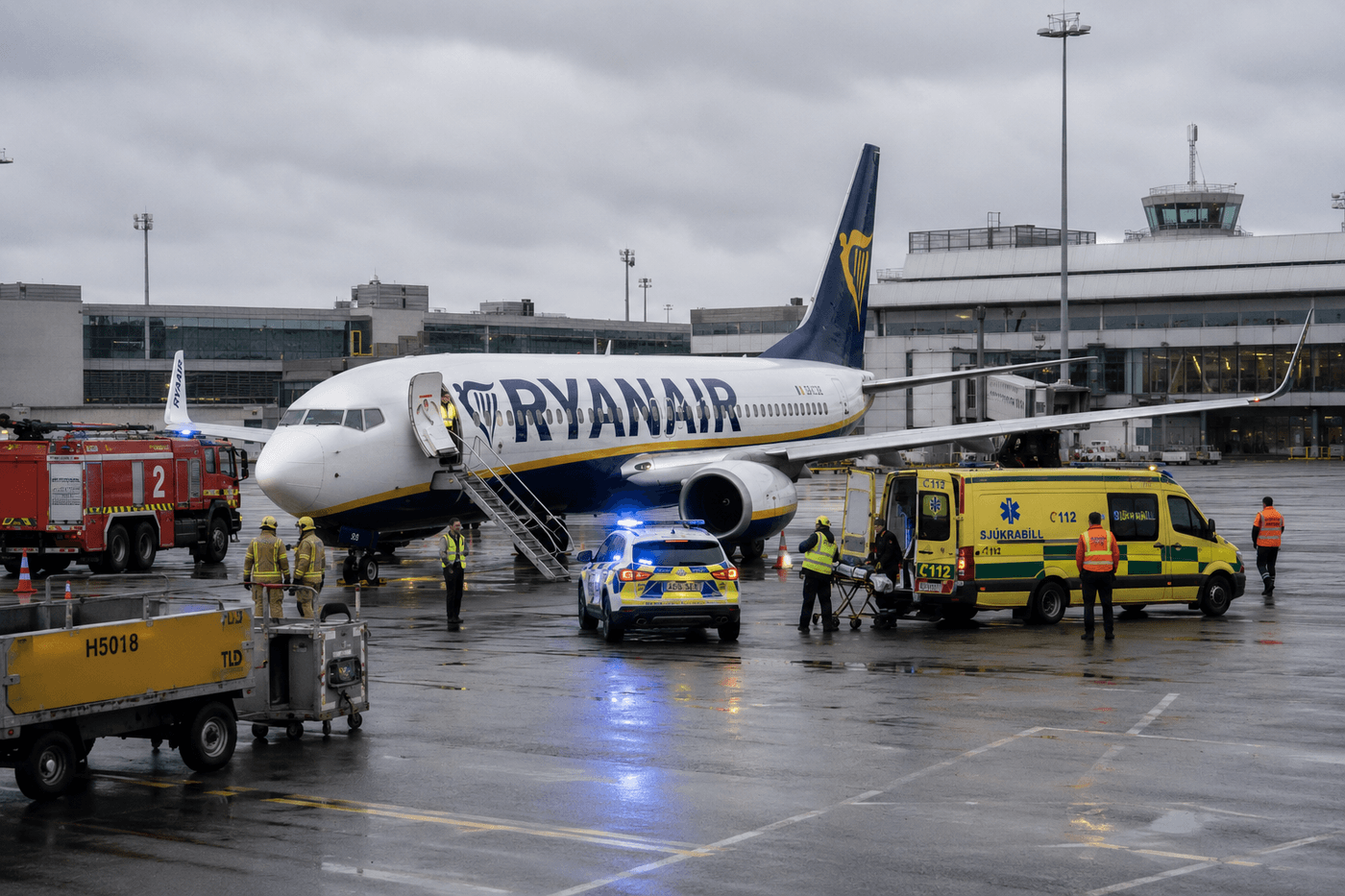
A 61-year-old Serbian tourist was partially pulled through a shattered cabin window on a Ryanair flight shortly after takeoff from Thessaloniki, Greece, this week when engine debris struck and broke the window, causing a decompression event that drew the man's head and shoulders outside the aircraft before fellow passengers and his wife physically held him in his seat.
Ryanair Flight 1879 was en route from Thessaloniki's Macedonia International Airport to Memmingen, Germany, when a piece of debris detached from one of the aircraft's engines and struck a passenger window, shattering it at altitude. The sudden depressurization woke most sleeping passengers — one witness describing the sound as similar to a tire bursting — and oxygen masks dropped from the overhead panels. The Serbian passenger had not removed his seatbelt, a fact that almost certainly saved his life. His wife and nearby passengers gripped him to keep him from being further drawn through the opening as the flight crew initiated an emergency return to Thessaloniki. The plane landed normally and the passenger was transported for medical treatment on the ground, where he was found to have sustained friction burns and shock but no life-threatening injuries.
"The masks dropped and there was a strong smell. The head and shoulders of one passenger were outside the window. Fortunately, he hadn't taken off his seat belt." — Eyewitness passenger, Radio Thessaloniki
Ryanair confirmed to media that the flight returned to Thessaloniki "shortly after take-off when a passenger window dislodged inflight," adding that the aircraft landed normally and that a replacement plane was arranged to carry passengers on to their destination in Germany. The airline's statement notably did not describe the mechanism of the window failure, the source of the engine debris, or the nature of the passenger's injuries — characterizing only that one passenger "requested and received medical assistance." Greek aviation authorities have launched an investigation. Two industry sources confirmed to Reuters that the passenger was indeed partially drawn through the broken window.
The incident draws immediate comparisons to two prior high-profile window failures. In April 2018, a Southwest Airlines flight suffered engine failure that sent debris through a cabin window, partially pulling a passenger out of the aircraft; she died of her injuries — the first U.S. commercial aviation fatality in nearly a decade at the time. In January 2024, a door plug blew out of an Alaska Airlines Boeing 737 Max 9 shortly after takeoff, depressurizing the cabin and creating an opening through which a child's shirt was sucked out; all aboard survived. The Thessaloniki incident adds to a string of cabin integrity events that have renewed scrutiny of aircraft maintenance practices and engine debris containment systems at low-cost carriers operating high-frequency short-haul routes.
Ryanair is Europe's largest low-cost carrier by passenger volume, operating a fleet of more than 600 Boeing 737 aircraft across more than 40 countries. The airline operates a high-utilization, short-turnaround business model that maximizes aircraft flying hours. Greek aviation accident investigators from the Hellenic Air Accident Investigation and Aviation Safety Board have initiated a formal investigation into the Thessaloniki incident. The passenger's seatbelt remaining fastened is credited by witnesses and sources as the primary reason he survived without serious injury.
The Serbian tourist on Flight 1879 is alive today because he kept his seatbelt fastened. That single decision — the one safety instruction every flight crew repeats before every departure — is what separated a remarkable survival story from a fatality. The investigation into the engine debris failure and window breach will determine what went wrong mechanically. What is already clear is that the basic advice to keep your seatbelt buckled when seated is not a formality. On Tuesday over the Aegean, it was the difference between life and death.