
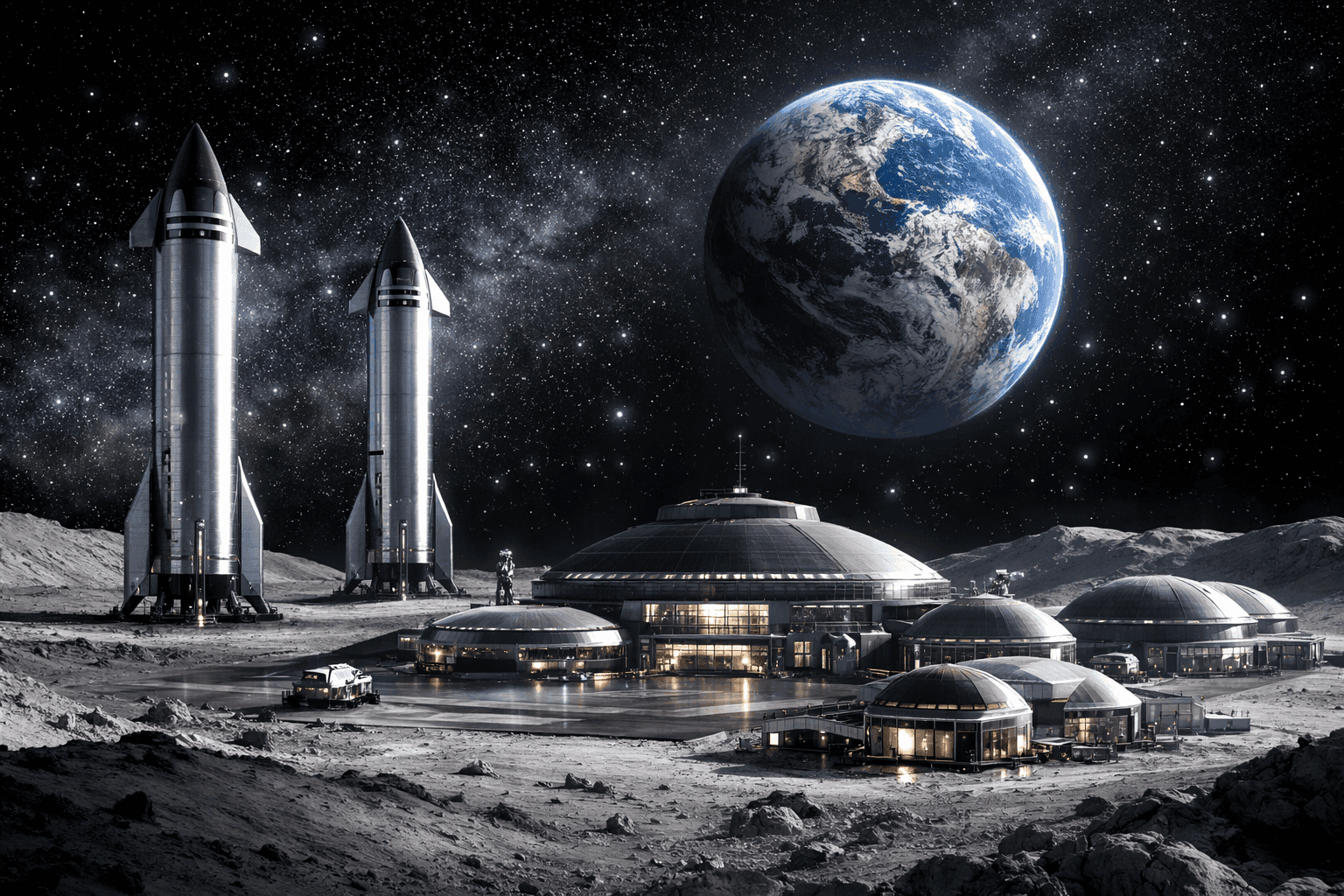
Elon Musk has announced a dramatic strategic pivot placing lunar development ahead of Mars colonization, arguing that the Moon's proximity enables faster iteration cycles essential for building what he describes as a self-growing city beyond Earth.
SpaceX's recent acquisition of xAI factors prominently into the revised timeline, with Musk framing artificial intelligence as crucial for accelerating construction of lunar infrastructure that will eventually inform Martian settlement approaches. The Moon-first strategy exploits frequent launch windows unavailable for Mars missions, which occur only every twenty-six months when planetary alignment permits efficient travel.
Conservative space policy advocates generally support ambitious exploration goals while maintaining healthy skepticism about Musk's notorious timeline optimism. His track record includes consistently missing self-imposed deadlines by years, though SpaceX has ultimately delivered revolutionary capabilities that transformed space access even when arriving later than initially promised.
"Musk says SpaceX is prioritizing a self-growing city on the Moon because it allows faster iteration than Mars thanks to frequent launch windows, though experts question the under-ten-years timeline."
NASA's Artemis program and SpaceX's three billion dollar Starship lunar lander contract provide substantial foundation for expanded lunar operations. However, transitioning from scientific outposts to Musk's vision of self-sustaining cities requires technological breakthroughs in life support, resource extraction, radiation protection, and autonomous construction that remain largely theoretical despite rapid recent progress.
The Moon presents significant advantages over Mars including communication delays measured in seconds rather than minutes, emergency return capabilities within days instead of years, and the ability to test systems with Earth's industrial base readily accessible. These factors make lunar development logical preparation for eventual Martian settlement despite Mars's superior resource availability and Earth-like day length.
Musk's Moon-first pivot demonstrates pragmatic adaptation rather than abandoning Mars ambitions entirely. Learning to establish self-sufficient settlements on the Moon solves many challenges that Martian colonization will face while maintaining momentum toward multi-planetary civilization goals. Whether SpaceX can deliver lunar cities within ten years remains doubtful given historical timeline slippage, but the strategic logic appears sound. American space leadership requires pushing technological boundaries even when specific timelines prove optimistic. Better to aim for revolutionary achievements that arrive late than settle for incremental progress that never transforms humanity's relationship with space.