
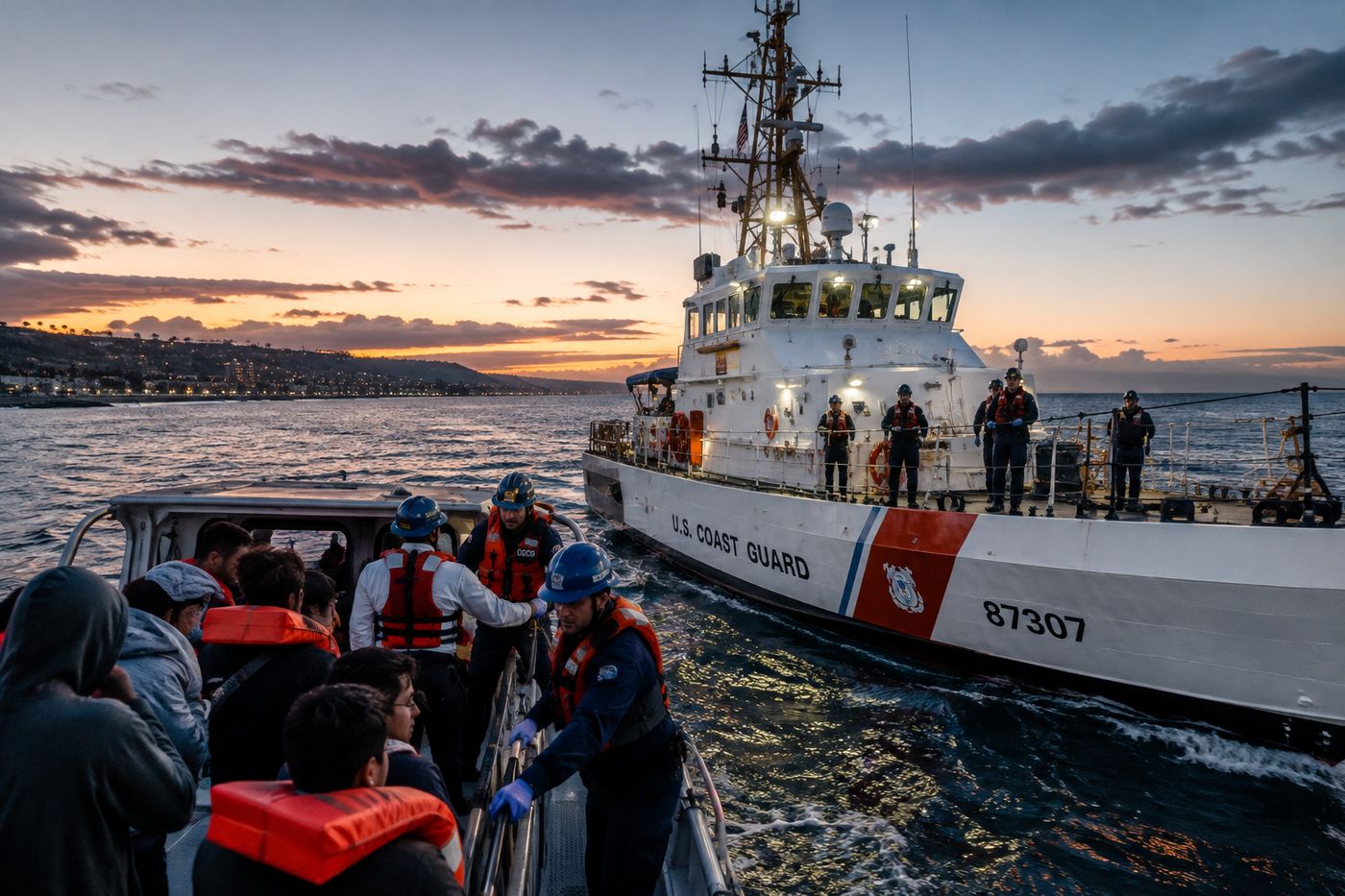
The U.S. Coast Guard rescued 37 suspected migrants from a 30-foot pleasure craft Friday evening after the vessel had been drifting without fuel, food, or water for two days approximately 88 miles offshore from Channel Islands Harbor in Southern California — a rescue that unfolded in rough conditions and darkness, and that ended with all 37 survivors transferred to Border Patrol custody.
The rescue began at approximately 3:40 p.m. Friday when the vessel's operator radioed the Coast Guard for help, reporting the dire conditions aboard the craft. The operator stated the boat had been adrift for two days without fuel, food, or water and that no personal safety equipment was on board. The Coast Guard dispatched multiple assets — including the cutters Sockeye and Halibut, small boats from stations in Los Angeles-Long Beach and Channel Islands, and an air crew — to locate the vessel. Rescue crews found the boat at approximately 8:30 p.m. and brought all 37 individuals aboard the Sockeye for medical assessment and transport. The cutter delivered the group to Coast Guard Base Los Angeles-Long Beach, where they were turned over to U.S. Border Patrol agents for processing.
"Despite operating far offshore in rough conditions at night, they persevered until every person in danger was rescued. Their extraordinary professionalism, superb judgment, and impeccable seamanship shined throughout the entire case." — Master Chief Peter Nelson, officer in charge of the Sockeye
The Coast Guard did not immediately release information on the migrants' nationalities, the origin of the vessel, or its intended destination. The incident follows a broader pattern of maritime smuggling operations off the Southern California coast that has continued despite a dramatic 90% decline in land-border crossings since the start of the Trump administration's enforcement push. As overland entry routes have tightened — crossings fell from more than 144,000 encounters in December 2024 to approximately 13,500 in May 2026 — smuggling networks have adapted by shifting more operations to maritime routes, accepting significantly greater risk to their human cargo in the process.
Two days at sea without food, fuel, or water on a 30-foot vessel with 37 people aboard is not a minor hardship — it is a life-threatening situation that human smuggling networks create deliberately, charging migrants thousands of dollars for passage on boats they know are dangerously inadequate for open-ocean voyages. The Coast Guard's men and women perform these rescues with skill and professionalism that deserves recognition. But the existence of such a robust maritime smuggling market off the California coast is also a reminder that border security is not simply a function of what happens on land. As long as demand for illegal entry exists and smuggling networks profit from meeting it, the methods will continue to adapt.
Maritime migration off the California coast typically involves departure from Mexico — most often from the Baja California coastline — with small vessels attempting to reach California ports or beaches. The California Channel Islands lie between 12 and 70 miles offshore, and maritime crossings in the area can take multiple days depending on conditions and vessel capability. U.S. Customs and Border Protection, working alongside the Coast Guard, has conducted numerous joint maritime interdiction operations off the Southern California coast in 2026.
Thirty-seven people spent two days drifting in the Pacific Ocean on a boat with no fuel, no food, and no water because the people who took their money and put them on that vessel didn't care whether they lived or died. The Coast Guard brought them home safely. The Border Patrol will now process them through the immigration system. The smuggling networks that endangered their lives will find the next boat. Until the demand and the profit that drives it are addressed at the source, these rescues will continue indefinitely.