
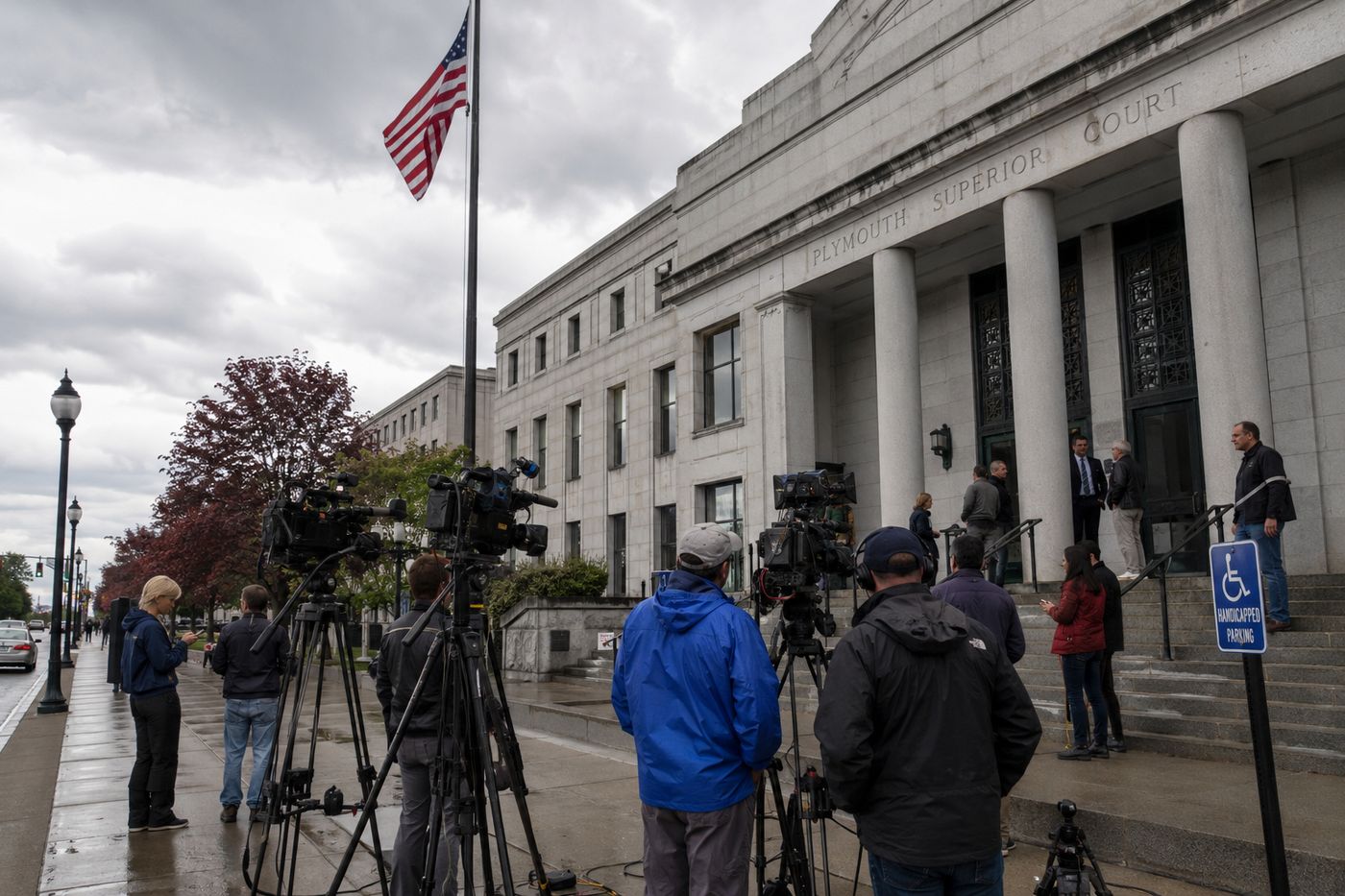
The Lindsay Clancy murder trial entered its fifth day of deliberations Wednesday morning with the nine women and three men of the jury having spent more than 23 hours weighing the case without reaching a unanimous decision — as Judge William Sullivan issued a pointed warning from the bench that rules governing the proceedings "will be enforced," one day after a woman was arrested outside the Plymouth courthouse and charged with filming jurors in the parking lot.
Dawn Light, 56, of Sutton, Massachusetts — a retired registered nurse with no prior criminal record — was taken into custody Tuesday afternoon at approximately 3:40 p.m. outside the Plymouth Superior Court building. Prosecutors said Wednesday at her arraignment that video recovered from her phone's deleted folder showed Clancy jurors leaving the courthouse. Light was charged with intimidation of a witness, juror, or person furnishing information in a criminal proceeding. Her attorney said it was a "complete misunderstanding" — that Light was trying to photograph Clancy herself, not the jurors — and the judge released her without cash bail. Defense attorney Kevin Reddington, asked about the arrest as he arrived at the courthouse Wednesday, said it "doesn't affect us at all." The panel had been expected to send back another note Wednesday; as of midday, no communication had been received from the jury room.
"It is common for juries that eventually reach a verdict, especially in highly emotional cases, to initially report that they are deadlocked. So you could see a unanimous verdict later in this case. There should be no rush to judgment." — Retired Massachusetts Superior Judge Jack Lu
On Tuesday — the fourth day of deliberations — the jury sent a note to Judge Sullivan stating that "after many hours of deliberation, we are unable to come to a unanimous decision." Sullivan declined to declare a mistrial and instead directed jurors to return Wednesday and continue, reminding them of the seriousness of the case and the volume of evidence: more than 80 witnesses and 300 exhibits. Sullivan also said Wednesday morning that he had issued individual side-bar instructions to the jurors, with each juror affirming something at sidebar that could not be heard by those in the courtroom. Legal observers interpreted the procedure as a check on whether any juror felt pressure to reach a verdict against their individual judgment — a standard inquiry in deadlock situations under Massachusetts law.
Clancy, 36, does not dispute that she strangled her three young children — Cora, 5, Dawson, 3, and Callan, 8 months — at the family's Duxbury home on January 24, 2023. The sole question before the jury is whether she was criminally responsible for those killings, or whether postpartum psychosis robbed her of the ability to understand that what she was doing was wrong. The prosecution argues she knew exactly what she was doing and hid her thoughts from doctors because she recognized their wrongness. The defense presented expert testimony that her illness had reached psychotic levels. A conviction carries a mandatory sentence of life without parole under Massachusetts law.
Judge Sullivan has not yet given the jury a "Tuey-Rodriguez" instruction — the Massachusetts equivalent of an Allen charge — which would be a stronger directive urging holdout jurors to seriously reconsider their positions in light of the views of their fellow jurors. Such an instruction is typically reserved for situations where a judge concludes the deadlock may be resolvable with additional encouragement rather than an irreconcilable impasse. Both sides have indicated they expect the case to reach a resolution this week, whether by verdict or declaration of mistrial.
Whatever the jury decides about Lindsay Clancy's mental state in January 2023, the proceedings have consumed months and produced a national debate about maternal mental health, the limits of criminal responsibility, and what the law owes to victims who cannot speak for themselves. The names the public would do well to remember are Cora, Dawson, and Callan — three children who had their entire lives ahead of them. The jury that holds their memory in its hands is still deliberating.