
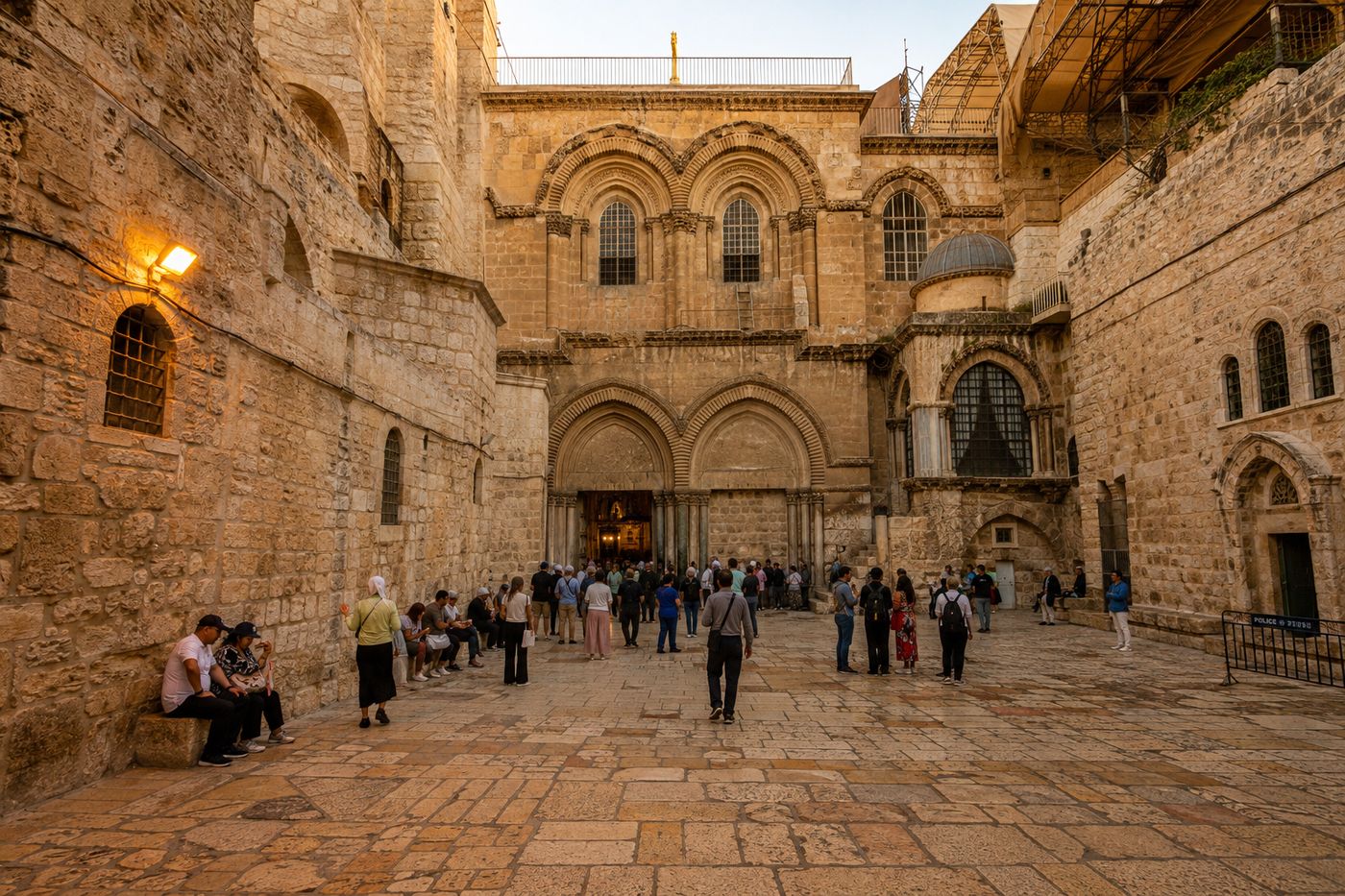
A completed archaeological excavation beneath Jerusalem's Church of the Holy Sepulchre — one of Christianity's most sacred sites, venerated for nearly 1,700 years as the place where Jesus Christ was crucified and buried — has uncovered ancient seeds and pollen confirming that a garden existed at the site during the first century A.D., providing direct archaeological support for a detail that skeptics had long dismissed as embellishment in the Gospel of John.
The excavation was led by Professor Francesca Stasolla of the Sapienza University of Rome and completed in 2025. A 98-page preliminary report on the campaign's findings was published in Liber Annuus, the peer-reviewed archaeological journal of Jerusalem's Studium Biblicum Franciscanum. The seeds and pollen were found in layers dating to the period between the site's use as an ancient stone quarry and its subsequent Roman-era occupation — precisely the timeframe of the first century A.D. when, according to the Gospels, Jesus was crucified and laid in a nearby tomb. The excavation also recovered evidence that the quarry was gradually abandoned and its cleared areas transitioned to agricultural use and burial grounds — consistent with a garden setting in the period of Jesus' death.
"Scholars have largely doubted whether or not Jesus would have been buried in an orchard. But instead we find confirmed that there was a garden there — and so the Gospel of John has been proven to be accurate again in the details." — Douglas Estes, New College of Florida
The significance of this finding lies in what John 19:41 says about the crucifixion scene: "Now in the place where he was crucified there was a garden, and in the garden a new tomb in which no one had yet been laid." Critics of the Gospel of John — which has historically been viewed by secular scholars as less historically reliable than the synoptic Gospels of Matthew, Mark, and Luke — had pointed to the garden detail as an example of later theological embellishment. The archaeological evidence now indicates the garden was real. This is not the first time archaeology has vindicated a detail specific to John's Gospel. In the 19th century, scholars doubted John's description of five colonnades at the Pool of Bethesda. Later excavations confirmed all five.
Douglas Estes, an associate professor of religion at New College of Florida who specializes in early Christianity and was not involved in the excavation, told Fox News Digital the findings were personally exciting and that archaeology has "over time, confirmed, again and again, details from the Gospel of John." The Church of the Holy Sepulchre was identified as Jesus' burial place under Emperor Constantine in the fourth century, when the first church was built on the site. It has been a continuous site of Christian pilgrimage ever since. The ongoing excavations are giving archaeologists the clearest picture yet of what the surrounding landscape looked like at the time of Jesus — and what they are finding is increasingly consistent with what the New Testament says.
The full results of the Stasolla-led excavation were published in Liber Annuus, the journal of the Studium Biblicum Franciscanum — a leading center for biblical archaeology in Jerusalem. The Church of the Holy Sepulchre is shared by six Christian denominations including the Greek Orthodox, Roman Catholic, Armenian Apostolic, Coptic, Ethiopian, and Syriac Orthodox churches, each controlling specific areas of the complex. Archaeological access to the site requires the cooperation of all custodial communities, making such excavations rare and the findings particularly valuable.
For Christians, the discovery is a quiet but meaningful confirmation — not of faith itself, which does not require archaeological validation, but of the historical credibility of the texts through which that faith was transmitted. For scholars and skeptics alike, it is a reminder that dismissing the Gospel of John as embellishment has repeatedly proven premature. The pool with five colonnades was real. The garden at Golgotha was real. The excavations beneath the Church of the Holy Sepulchre are still ongoing — and whatever they uncover next, the record suggests it will be worth paying attention to.