

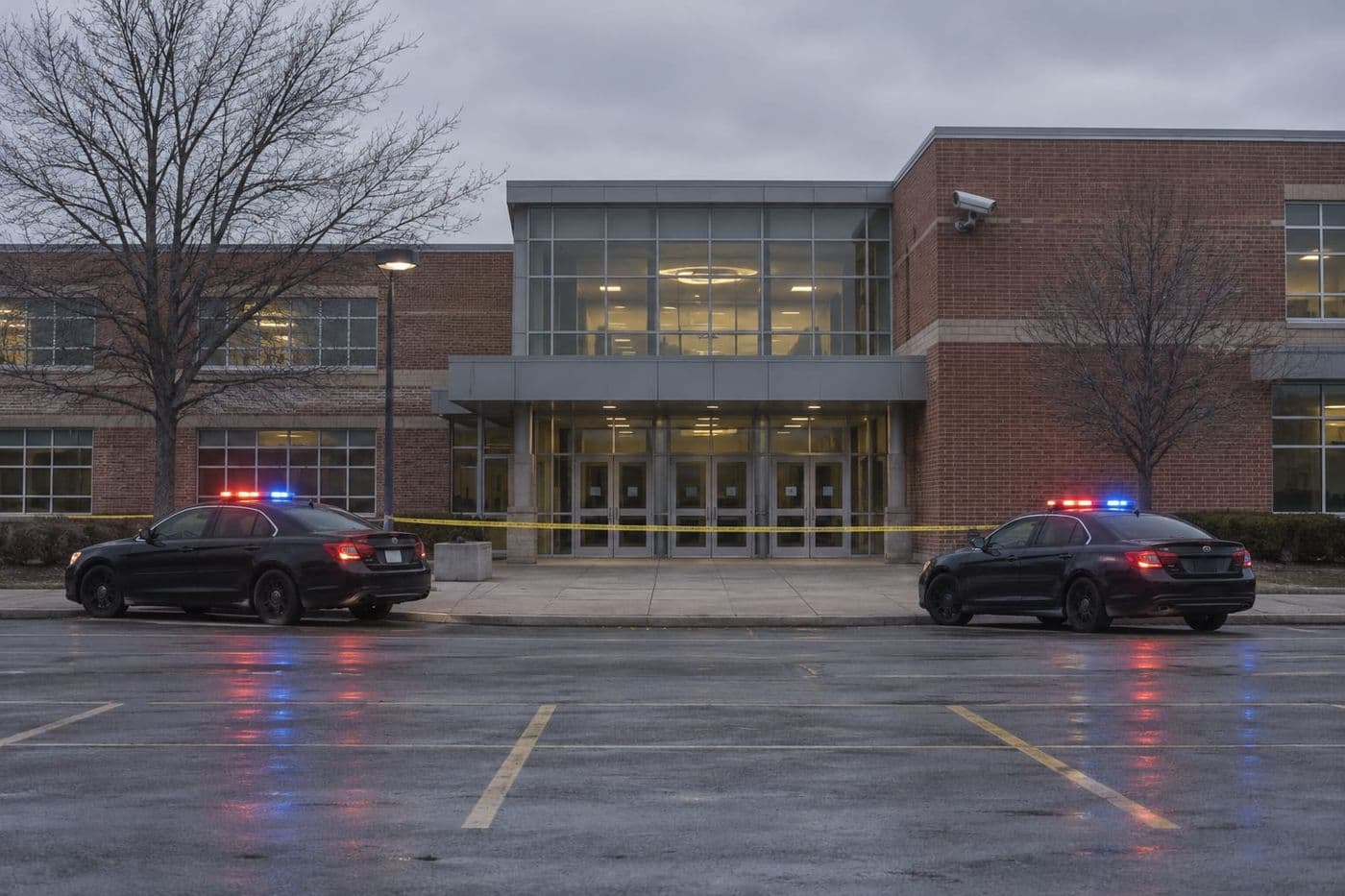
Baltimore police handcuffed teenagers at a school after an artificial intelligence security system mistook a bag of potato chips for a gun — a case that shows what happens when a school hands its first judgment call to software and its second to armed officers who have only seconds to decide.
The sequence is simple, and that is what makes it troubling. An AI weapons-detection system, the kind that scans camera video for shapes that resemble firearms, flagged an object at the school as a possible gun. Police responded to a report of an armed threat. Officers detained the teens and put them in handcuffs. The object turned out to be a bag of potato chips. Systems of this type generally work by comparing what a camera sees against patterns the software has been trained to associate with weapons. They do not understand context. They measure resemblance, and a crumpled foil bag held at a certain angle can resemble many things. A human reviewer is supposed to sit between the alert and the police call, and the design only works if that person has the time, the training and the authority to say the alert is wrong. Once officers are dispatched to a possible gun at a school, the situation changes. Responders arrive expecting the worst, and the teens in front of them become suspects until proven otherwise. A false positive stops being a software error and becomes a physical encounter with young people, handcuffs and a campus on edge.
An artificial intelligence system flagged a snack bag as a firearm, and teenagers ended up in handcuffs over it.
Schools across the country have spent the last several years buying security technology in the wake of mass shootings, and AI-based weapons detection has become one of the fastest-growing categories. The pitch is easy to understand. A camera never blinks, never gets tired, and can watch hundreds of feeds at once. Administrators who face enormous pressure to prevent the next tragedy are told that software can spot a gun before anyone pulls a trigger. The trouble is that a detection tool is only as good as its error rate, and the public rarely sees that number. A system that is right nearly every time can still produce a steady stream of false alarms when it watches thousands of students carrying backpacks, phones, water bottles and snacks every day. Each false alarm that reaches police carries real risk. The Baltimore case is a reminder that the machine is not the final decision maker only if people choose to make it so, and that the cost of a wrong call lands on children who did nothing wrong.
Nobody should dismiss the concern behind these systems. Parents want their kids safe, and school leaders do not want to explain why a warning sign was missed. Wanting early detection is reasonable. But a safety measure that handcuffs innocent teenagers over a snack is not delivering safety. It is delivering the appearance of it. The conservative principle at stake is accountability. When a government agency or a public school buys a tool, taxpayers deserve to know what it costs, how often it is wrong, who reviews its alerts, and who answers when it fails. Technology sold on confidence should be held to evidence. Before any district signs another contract, it should demand published error rates, written rules requiring human confirmation before police are called, and a clear process for responding when the alert turns out to be false. Common sense still counts. A trained adult looking at a clear image could have caught this before anyone reached for handcuffs.
A false positive is an alert that says a threat is present when none exists. In weapons detection, vendors often promote accuracy, but accuracy alone hides the problem: when real weapons are extremely rare, even a small false-alarm rate can generate many wrong alerts over a school year. The key question is not whether the software is usually right, but what happens in the moments after it is wrong. Human review is only a safeguard if the reviewer can overrule the machine quickly and the school has a procedure for downgrading an alert before police arrive. Without that, the technology simply moves the mistake faster.
Source:nbcnews.com
Think of the smoke detector that goes off every time someone makes toast. After a few false alarms, people stop trusting it, or they rip out the battery. Schools cannot afford either outcome, and neither can the students who get caught in the middle. Technology can help, but only when it is treated as a tool with known limits instead of an oracle that cannot be questioned. Families deserve proof that these systems work before their children are the test. A snack bag should never be mistaken for a gun, and no teenager should learn about artificial intelligence from the wrong end of a pair of handcuffs. Trust the tool only as far as a human being is willing to check it.