
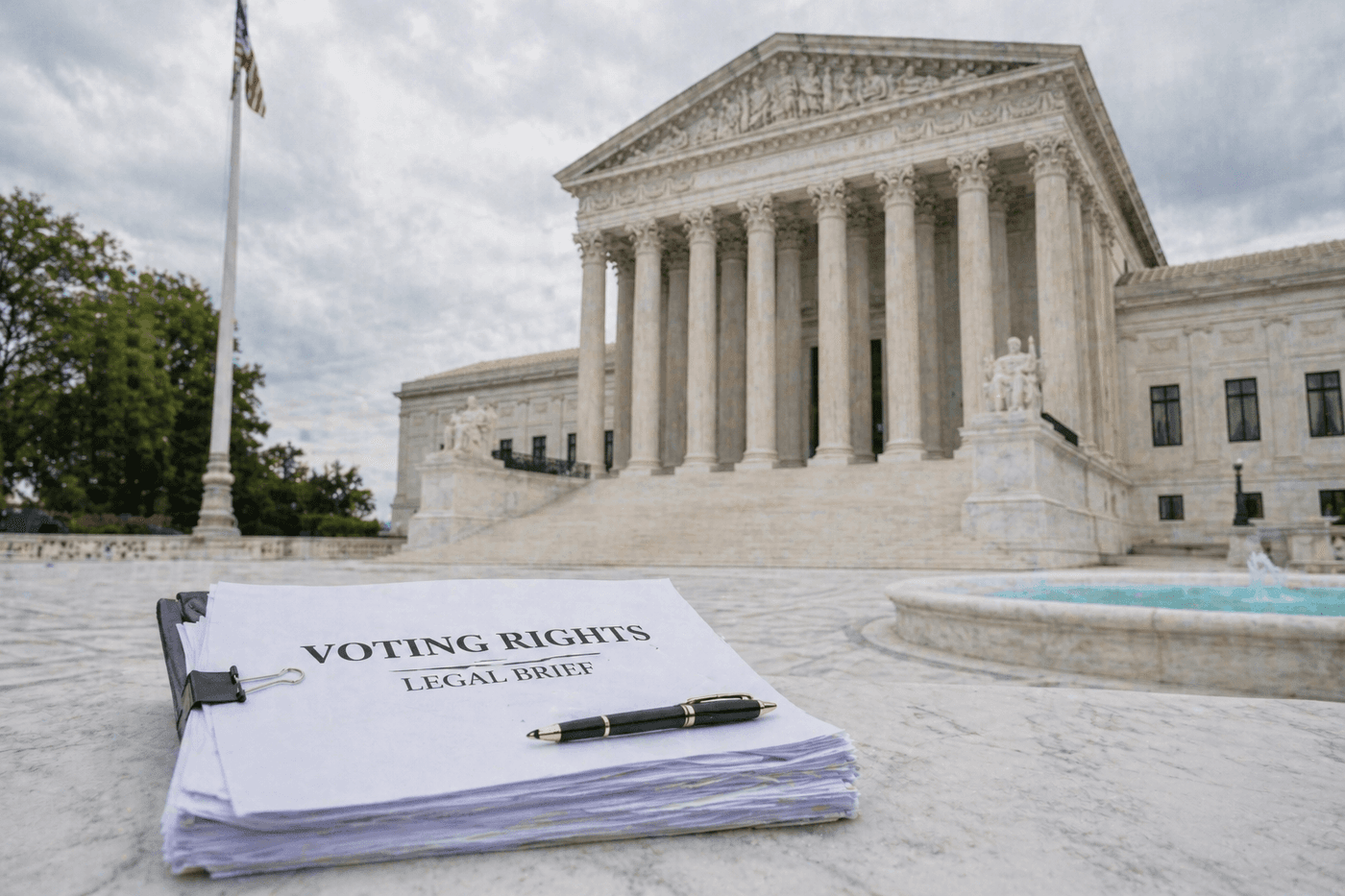
The Supreme Court limited the scope of a key Voting Rights Act provision restricting how states draw districts affecting minority voters, ruling 6-3 that Louisiana's newly redrawn congressional map creating a second majority-Black district constitutes an illegal racial gerrymander ahead of 2026 midterms.
Justice Samuel Alito, writing for the majority, acknowledged that Voting Rights Act compliance can provide compelling interest for states but ruled it did not require Louisiana to create the new map with a second majority-Black district. The decision constrains states' use of race as a factor when drawing congressional maps without overturning the Voting Rights Act or Section 2 entirely.
"Compliance with Section 2, as properly construed, can provide such a reason. Correctly understood, Section 2 does not impose liability at odds with the Constitution, and it should not have imposed liability on Louisiana for its 2022 map."
The case, Louisiana v. Callais, was first argued last March with rare second arguments in October focused on whether Louisiana's map violated the Fourteenth or Fifteenth Amendments. Conservative justices appeared skeptical about keeping Section 2 of the VRA in place as is, pressing the NAACP lawyer on whether there should be time duration limits on intentional race use in drawing voting districts under the law.
Conservative legal scholars have long argued that race-based redistricting, even when intended to increase minority representation, violates constitutional equal protection principles. The ruling likely narrows how minority representation influences multiple states' congressional maps while triggering new legal challenges over congressional boundaries. Critics contend the Voting Rights Act has been weaponized to require racial gerrymandering that divides Americans by race rather than creating fair districts.
The dispute reached the high court after months of legal back-and-forth regarding Louisiana's 2024 congressional map. The decision arrives as Republicans and Democrats wage redistricting wars nationwide, with both parties attempting to maximize partisan advantages through creative district drawing that critics across the political spectrum condemn as undermining fair representation.
The Supreme Court's decision represents important step toward colorblind redistricting that draws districts based on legitimate factors rather than racial quotas. While ensuring minority voting rights remains important, constitutional principles prohibit using race as the predominant factor in drawing districts. States should create compact, contiguous districts respecting communities of interest without segregating voters by skin color—an approach that treats all citizens equally rather than dividing them into racial categories for political representation purposes that the Constitution fundamentally rejects.