
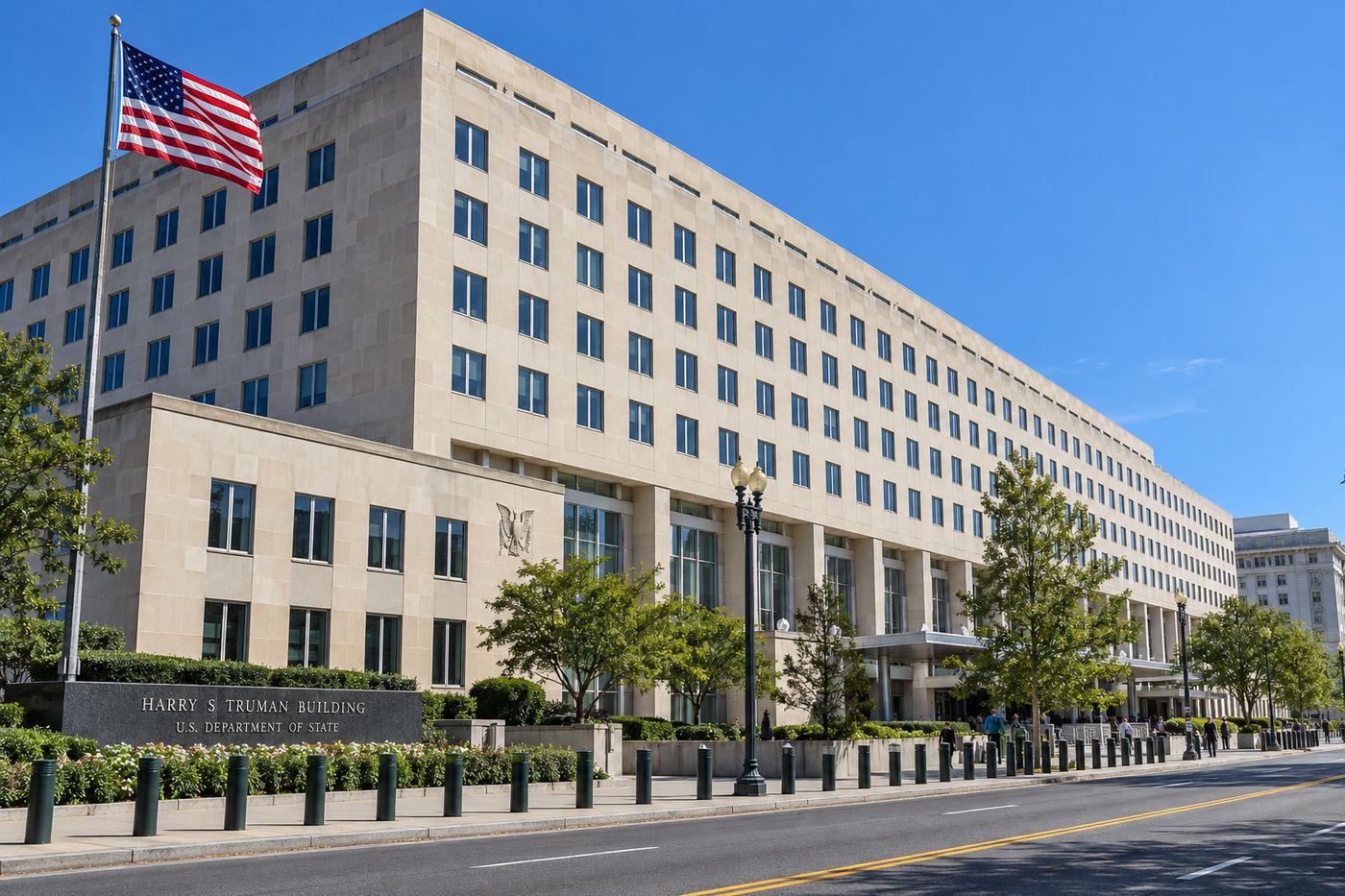
Secretary of State Marco Rubio waived a congressional restriction on $320 million in military aid to Egypt that had been withheld over human rights concerns — citing Cairo's role as a key mediator between the United States and Iran during Operation Epic Fury, the more than seven-month-old U.S.-Iran conflict, as the national security justification that allows the waiver to proceed under existing law.
The $320 million represents a portion of the United States' annual $1.3 billion in combined military and economic assistance to Egypt — specifically, foreign military financing that funds Egyptian purchases of U.S.-produced weaponry. Congress inserted the human rights certification requirement years ago in response to documented concerns about President Abdel Fattah al-Sisi's government, which the State Department's own annual human rights reports have linked to credible allegations of torture, arbitrary arrest, enforced disappearances, and severe restrictions on freedom of expression and assembly. Rubio's waiver — signed September 4 but confirmed publicly Thursday — invokes the national security exception written into the congressional restriction, arguing that maintaining Egypt's security cooperation at a moment of acute regional instability takes precedence over the human rights conditions. In his letter to congressional committees, Rubio cited Egypt's "helpful role" in the Iran conflict specifically as the operative justification.
"The waiver determination recognizes the importance of maintaining security cooperation with Egypt at a time of significant regional security challenges. Exercising this waiver authority is essential for the US-Egypt relationship and US national security priorities, particularly in light of Egypt's helpful role following Operation Epic Fury." — Secretary Rubio's memo, September 4, 2026
The decision is strategically defensible and strategically uncomfortable in equal measure. Egypt's geographic position — bordering Israel, Libya, Sudan, and with the Suez Canal under its control — makes it an indispensable regional partner that the United States cannot afford to alienate during an active military conflict with Iran. Cairo's role as a back-channel between Washington and Tehran during the conflict has been diplomatically significant in ways that American officials are reluctant to detail publicly but willing to invoke as waiver justification. The argument that regional security imperatives outweigh human rights conditions is not invented by this administration; the Biden administration issued a nearly identical waiver in September 2024, citing Egypt's assistance in Gaza ceasefire negotiations. Both Republican and Democratic administrations have treated the Egypt aid waiver as a routine instrument of regional realpolitik.
What critics find troubling is the signal the waiver sends to al-Sisi's government about the durability of any human rights conditions attached to American assistance. The waiver mechanism was designed to create leverage — to give Egypt an incentive to improve its human rights record by making aid conditional on measurable progress. When that conditionality is waived routinely for strategic reasons, the leverage disappears and the conditions become effectively meaningless. Egypt's human rights record under al-Sisi has not materially improved during years of routine waivers. Human rights organizations including Amnesty International and Human Rights Watch documented continued widespread abuses in Egypt through 2025.
Egypt receives approximately $1.3 billion annually in U.S. military and economic assistance — the third-largest U.S. foreign aid commitment after Israel and Ukraine. The relationship dates to the 1979 Camp David Accords. Egypt's military under President al-Sisi, who came to power in a 2013 coup, has been accused of holding over 60,000 political prisoners, suppressing independent journalism, and using mass trials to sentence political opponents. The U.S. State Department's own human rights report on Egypt has consistently documented these concerns even while successive administrations have issued aid waivers citing strategic necessity.
The case for Rubio's waiver is real: Egypt is mediating a conflict with Iran on America's behalf at a moment of acute regional instability, and disrupting that relationship over a human rights certification that both parties know will ultimately be waived serves nobody's interests. The case against it is equally real: every routine waiver teaches authoritarian governments that American human rights conditions are performative and negotiable. The Trump administration, like every administration before it, has chosen the strategic relationship over the principle. That is a defensible choice with defensible consequences — including the consequence that al-Sisi's government will continue to behave accordingly.