
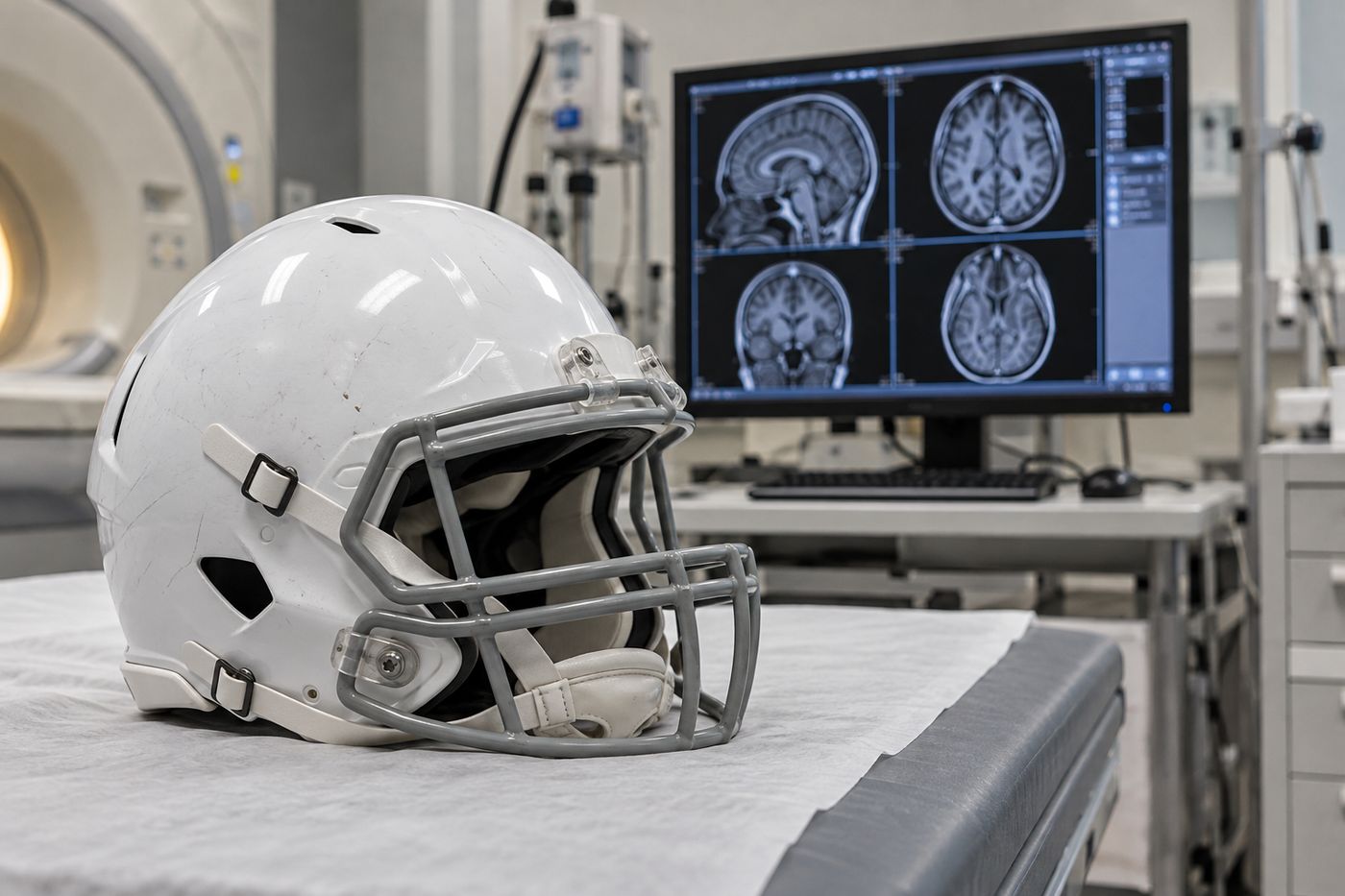
A landmark study published Wednesday in JAMA Network Open estimates that approximately 75% of former NFL players who died between 2008 and 2023 had chronic traumatic encephalopathy — the progressive brain disease caused by repeated head trauma — providing the first population-level CTE prevalence estimate ever produced for professional football players, and the most comprehensive accounting yet of the sport's neurological toll on the men who played it.
The research, led by biostatistics professor Yorghos Tripodis and his team at Boston University's CTE Center, combined data from the UNITE Brain Bank — which holds donated brains from deceased former NFL players — with national death records for all other former NFL players who died during the same 15-year period. In total, the analysis drew on data from 396 donated brains alongside information from 1,966 additional deceased players who did not donate their brains. Among those who did donate — the group for whom direct pathological examination was possible — 93.5% had confirmed CTE. But that figure has always been understood to overstate the prevalence across all former players because families whose loved ones showed CTE-related symptoms in life were approximately five times more likely to arrange donation than families of players who appeared neurologically healthy. Tripodis and his team constructed a statistical model adjusting for that donation bias, incorporating the ages at death and estimated rates of mild cognitive impairment and dementia in former players over 50. The resulting population-level estimate: 74.5% — meaning roughly 1,760 of the approximately 2,360 former NFL players who died during the 15-year study window likely had CTE at death.
"With CTE consistently found in less than 1% of donors to community brain banks, an estimated 75% prevalence among NFL players who died over a 16-year period is concerning, and suggests we need to increase efforts to support families, diagnose CTE during life, and treat CTE-related symptoms." — Julia Gallini, lead author, Boston University CTE Center
The magnitude of the gap between the NFL population and the general population cannot be overstated. CTE is found in less than 1% of brains donated to community brain banks from the general population — a figure so small it is statistically negligible. At 74.5% among former NFL players, the condition appears to be not a rare consequence of a career in professional football but an expected one. The study does not claim that every former player with CTE experienced severe symptoms — the 75% figure includes players with early pathological changes that may never have produced clinical symptoms in their lifetime. CTE exists on a spectrum from mild neuropathological changes to severe disease characterized by dementia, behavioral dysregulation, and impulse control failure. But even at the mild end of that spectrum, a 75% prevalence rate in a specific population is a public health data point of extraordinary significance.
The study also found that approximately 27% of former players in the analysis likely had dementia — a rate substantially higher than in the general male population of comparable age. CTE can only currently be confirmed through post-mortem brain examination, meaning no living player can be definitively diagnosed, though researchers are actively working to develop blood biomarkers and imaging techniques that might eventually permit diagnosis in living individuals. The study's authors are careful to note that its findings apply only to those who played in the NFL — not to college players, high school players, or players in other contact sports — and that it does not predict CTE rates among current or future players whose exposure may differ from the cohort studied.
Chronic traumatic encephalopathy was first formally described in NFL players by neuropathologist Dr. Bennet Omalu in 2005 in the case of former Pittsburgh Steelers center Mike Webster. The condition is characterized by the abnormal accumulation of tau protein in the brain — the same protein implicated in Alzheimer's disease, though distributed in distinct patterns that differentiate CTE pathologically. The NFL has faced multi-billion dollar litigation from former players and their families over CTE-related injuries. The league reached a class-action settlement in 2013 that has since paid out more than $1 billion to affected players. The study was published October 28, 2026 in JAMA Network Open and was supported by funding from the National Institutes of Health and the Concussion Legacy Foundation.
Three in four former NFL players who died over a fifteen-year period likely had a progressive brain disease caused by the repeated head trauma that is fundamental to professional football. That is not a fringe finding from an advocacy organization — it is a peer-reviewed, bias-adjusted estimate published in one of the world's most respected medical journals. What it means for the future of the sport, for the young men who aspire to play it, and for the families who will watch them is a question that the NFL, its players union, the medical community, and American society will be navigating for a long time. The data is no longer ambiguous.