
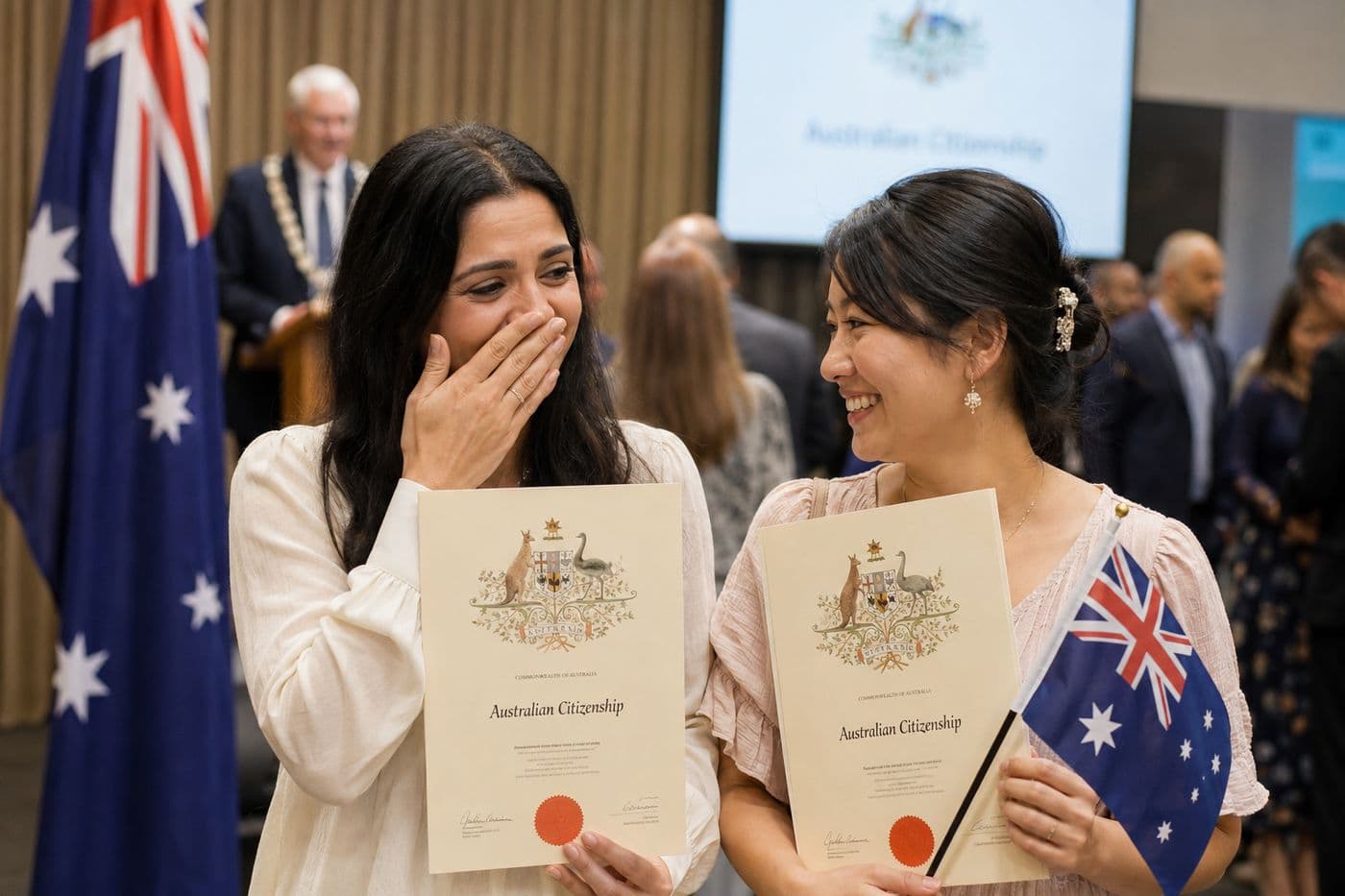
Two Iranian women's soccer players who defected from their national team during a Women's Asian Cup match in Australia in March — after an Iranian state television commentator branded them "wartime traitors" for playing a tournament held in a country participating in military operations against Iran — have been granted Australian citizenship in a fast-tracked ceremony that took place Wednesday in Brisbane.
Fatemeh Pasandideh and Atefeh Ramezanisadeh sought asylum immediately following the Asian Cup, refusing to return to Iran with the rest of the national team. The two players had been publicly condemned on Iranian state television during the tournament, with a commentator calling them traitors for competing on Australian soil while Iran was engaged in conflict with Western-allied nations. Both women remained in Brisbane following the tournament, applied for asylum, and were granted refugee status before being fast-tracked to full citizenship — a process that normally requires four years of residency in Australia on a valid visa. Immigration Minister Tony Burke personally swore both women in at a private ceremony attended by friends and supporters from Brisbane's Iranian community.
"Yesterday was a truly special and unforgettable day for me. I feel proud and deeply grateful to become an Australian citizen. Australia has given me the opportunity to build my life and my future, and I feel, more than ever, that I belong here." — Atefeh Ramezanisadeh
Australia's immigration department declined to explain why the women's citizenship was fast-tracked, citing privacy considerations on individual cases. The Refugee Council of Australia noted that the standard pathway to citizenship for refugees involves a minimum of four years on a valid visa before an application can be filed — a timeline the two players cleared in approximately five months. Football Federation Australia has not commented on whether Pasandideh or Ramezanisadeh will be eligible or considered for the Australian women's national team, the Matildas, but under FIFA eligibility rules a newly naturalized citizen is eligible to represent their new country provided they have not played a competitive international match for their birth nation at senior level within the preceding five years — a threshold both women may meet.
Their defection was part of a broader pattern of Iranian athletes refusing to return home during and after the U.S.-Iran conflict. The Iranian women's team competed under significant pressure throughout the Asian Cup, with players' families reportedly subject to government monitoring in Iran. The public branding of Pasandideh and Ramezanisadeh as traitors on state television appears to have been the decisive moment for both women — making a return to Iran not merely undesirable but potentially dangerous.
Australia has historically granted asylum to a relatively small number of Iranian nationals, with cases typically taking years to resolve through the country's immigration tribunal system. The speed of Pasandideh and Ramezanisadeh's citizenship — from asylum application to full citizenship in approximately five months — is highly unusual and reflects either the strength of their individual cases, the political sensitivity of their situation, or both. Iran has not publicly commented on the citizenship grants.
Two young women who played a sport they love were called traitors by their own government on national television for doing so. They made a decision that will define the rest of their lives — choosing freedom over home, uncertainty over subjugation — and Australia welcomed them. Whatever the bureaucratic machinery behind the fast-tracked citizenship, the human story is straightforward: two athletes refused to live under a regime that treats athletic competition as a political loyalty test, and a free country gave them the opportunity to build something new. That is what freedom looks like when it works.