
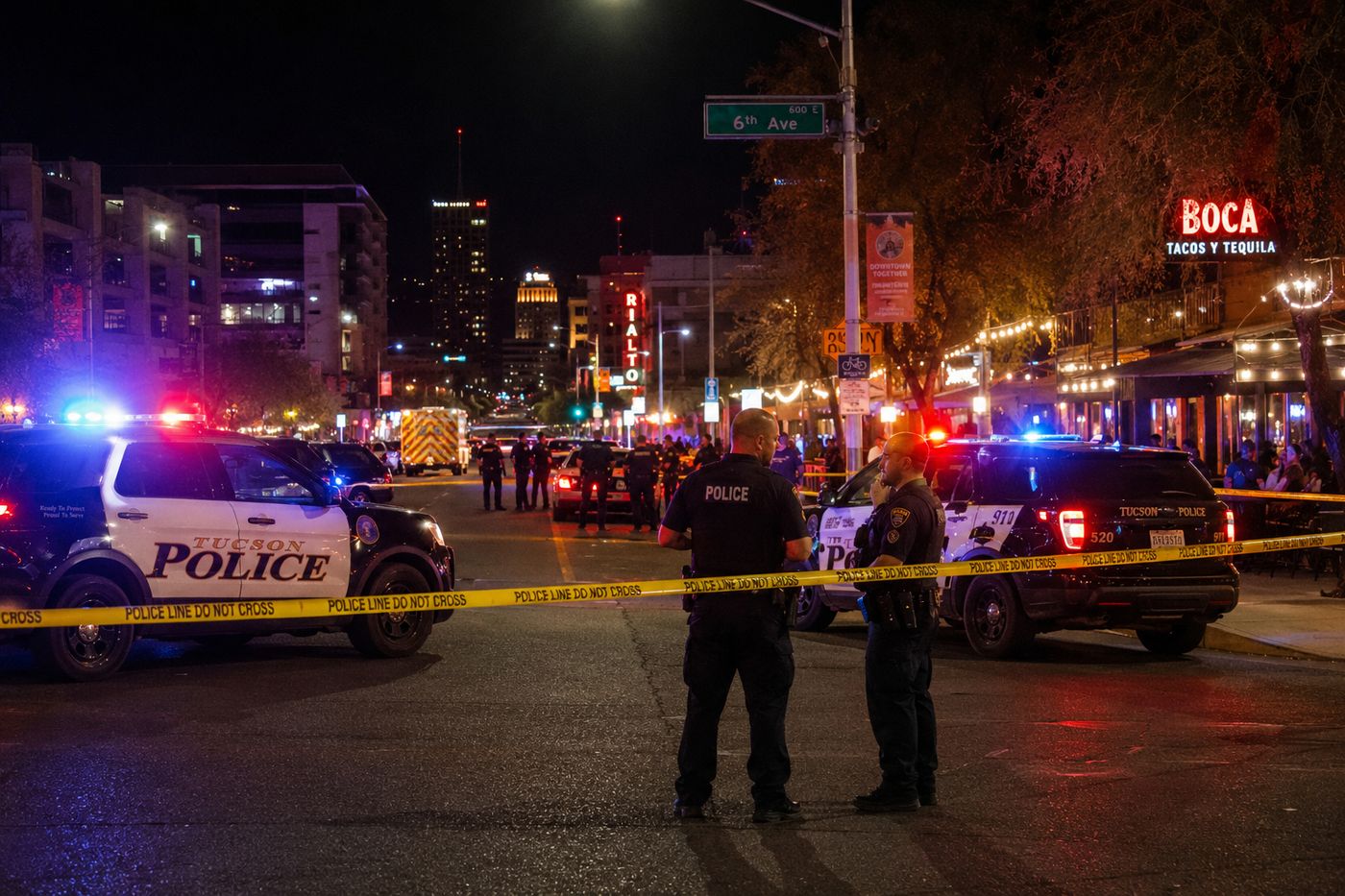
Nine people were wounded in a mass shooting in downtown Tucson's nightlife district in the early morning hours Saturday when a confrontation between two groups escalated into gunfire near Empire Pizza at East Congress Street and Sixth Avenue — a corner residents say has become so reliably dangerous after 1:30 a.m. that locals warn family members to leave before the bars close.
The shooting began around 2 a.m. as people were leaving bars and restaurants in the area. Police believe members of two groups who knew each other got into a physical altercation that rapidly escalated to gunfire, with bystanders caught in the crossfire. The alleged shooter was himself wounded and hospitalized in life-threatening condition. Empire Pizza, whose outdoor patio was struck by gunfire, issued a statement praising officers who reached the scene and began treating victims within approximately one minute — but paired that praise with a stark indictment of conditions in downtown Tucson. "It breaks our hearts to see what downtown has become," the restaurant wrote. "There is a stronger security presence guarding our bus station than any other business in downtown."
"I always tell my family and friends this: Once we're out at 1:30 a.m., let's go home. People get drunk, they want pizza, and it always happens right here. I've been through another shooting the exact same way right here on this corner." — Anais Camacho, Tucson resident
Democratic Tucson Mayor Regina Romero and former Rep. Gabby Giffords responded to the shooting by calling for stricter gun control legislation — pointing to Arizona's permissive gun laws and the absence of universal background checks as enabling factors. Republican Arizona Senate President Warren Petersen offered a different diagnosis: the violence underscores the need for law-abiding citizens to have the right to defend themselves. Both responses reflect a debate that has played out in Tucson and across Arizona for years without producing a policy consensus, while the violence at that particular downtown intersection has remained a persistent fixture of weekend nights.
The shooting is the latest in a pattern that residents of the Congress Street corridor know well. Tucson's downtown entertainment district draws large crowds on weekend nights, and the concentration of bars and late-night restaurants combined with inadequate security infrastructure has produced a recurring cycle of alcohol-fueled confrontations that occasionally turn deadly. Residents who spoke to local media described a community that has adapted its behavior around the violence — leaving before a certain hour, warning relatives away from specific intersections — rather than one that believes its city government has the situation under control.
Tucson is Arizona's second-largest city and has been governed by Democratic mayors for more than two decades. The city has seen periods of declining crime rates followed by surges, and its downtown entertainment district has been a recurring focal point for late-night violence. Arizona is a constitutional carry state, meaning residents may carry firearms without a permit. The shooting remains under active investigation by the Tucson Police Department.
When a longtime resident of a city knows from experience that a specific street corner produces a shooting nearly every weekend after 1:30 a.m., and her response is to warn her family rather than expect her city to fix it, that is a civic failure — not a gun policy failure. The weapons used Saturday night did not cause Tucson's downtown to deteriorate. Years of inadequate law enforcement, insufficient lighting and security infrastructure, and a political culture more interested in statewide gun legislation than neighborhood-level accountability produced the conditions that make Empire Pizza's patio a target. The guns are a symptom. The failure of governance is the disease.