
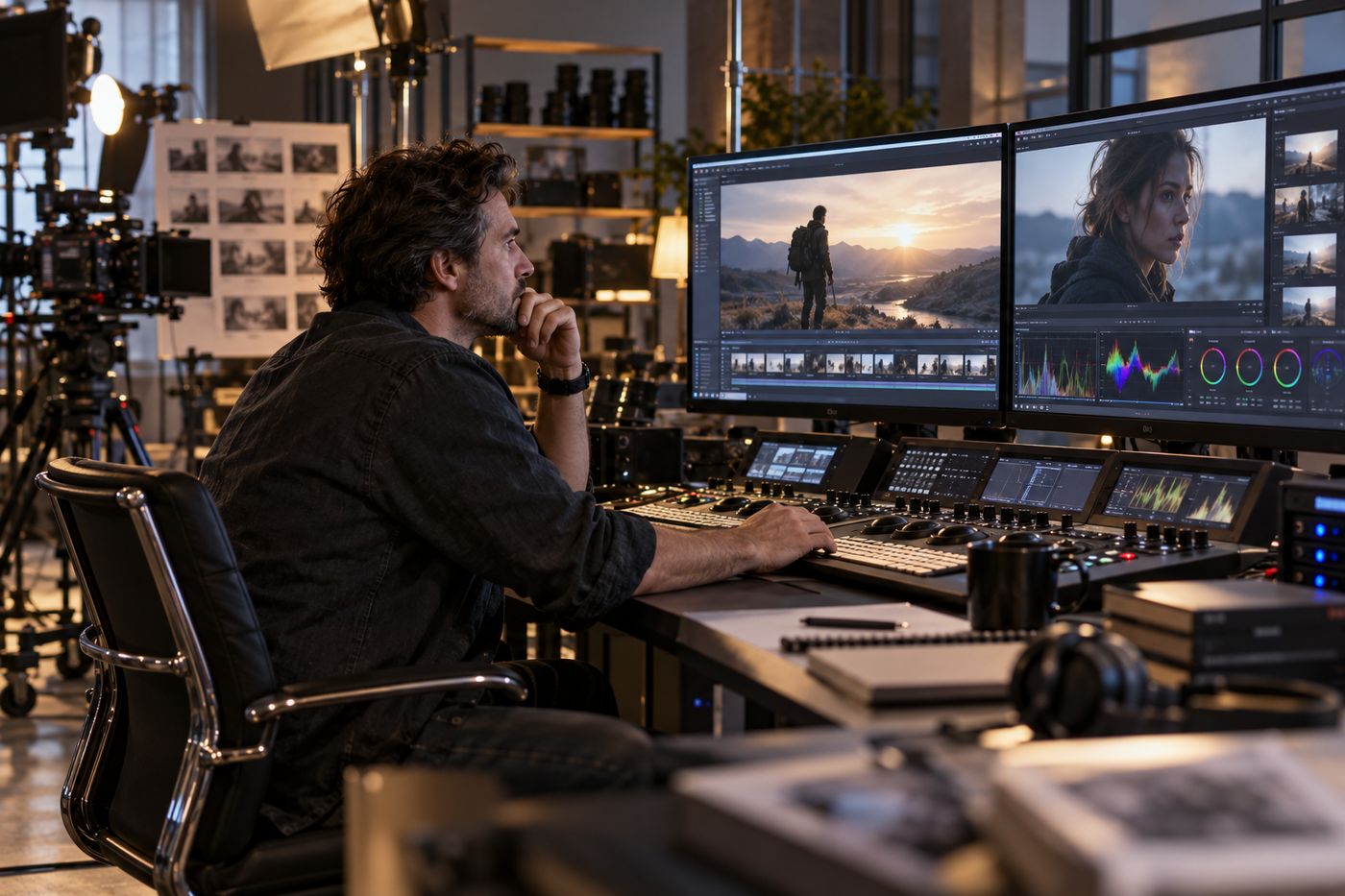
Oscar-winning filmmaker Ben Affleck appeared at the Bloomberg Screentime 2026 summit in Los Angeles on Wednesday to push back against what he called "propaganda" surrounding artificial intelligence in Hollywood — telling the audience that he used AI for "lots of things" on his upcoming Netflix thriller "Animals" and arguing that filmmakers who sit with the technology quickly move from fear to recognition that it is simply a better tool, not an existential threat to their craft.
Affleck made headlines in July when it emerged that Netflix had paid $587 million for his AI startup InterPositive — a venture that had operated largely under the radar until the deal was announced. At the Bloomberg summit, he addressed the cynical take that Netflix had purchased his company primarily to acquire a respected filmmaker's name as cover for AI deployment that would otherwise draw industry opposition. Affleck rejected the framing, insisting Netflix is "super judicious" about his projects and is not positioned to do "despicable things" that would alienate the artists it needs to remain in business with. His defense of AI in the industry was substantive rather than promotional: he described sitting down with directors, showing them specific applications, and watching the resistance dissolve when abstract fear was replaced by direct experience of what the technology actually does. "It moves from this nebulous abstract terrifying alien, you know, 'It's gonna kill us all like we're paper clips' — all this propaganda," Affleck said. "And they actually see what it is — it's another form of computing that does tools and is a technological advancement that's really in keeping with a long-standing series of technological improvements we've made in the film and television business."
"When I worry about AI, I worry about my kids in school. I worry about learned helplessness. I worry about responsible use. I don't worry about Skynet and I don't think it's going to take over this business in any meaningful way. I think it's going to be additive." — Ben Affleck, Bloomberg Screentime 2026
Affleck's distinction between legitimate AI concerns and doomsday-adjacent propaganda is essentially the same argument Jensen Huang made earlier this month — and for similar reasons. Both are people who work closely with AI tools, understand their actual capabilities and limitations, and are frustrated by a public conversation dominated by people who understand them abstractly rather than practically. The specific concerns Affleck does take seriously are precisely the ones most grounded in daily reality: grade inflation at colleges enabled by AI assistance, what he called a 30% rise in A's over three years, and the broader risk of "learned helplessness" — a generation that cannot think independently because it has outsourced the cognitive effort to a machine. Those are real concerns. Skynet is not.
The Hollywood context for Affleck's remarks is significant. The Writers Guild and SAG-AFTRA fought extended strikes in 2023 in part over AI provisions, and the resulting contracts placed guardrails on how studios could use AI-generated content without union involvement. That negotiated framework has not resolved the industry's anxiety about the technology — it has simply provided a contractual structure within which the anxiety continues to operate. Affleck's argument is that the fear is outpacing reality and that filmmakers who actually use the tools discover a more modest and more manageable reality than the worst-case scenarios suggest.
InterPositive, the AI startup Affleck founded, focused on AI tools for visual effects, post-production, and film pre-visualization — applications that augment the filmmaking process rather than replace human creative judgment. Netflix's $587 million acquisition price was widely noted as extraordinary, raising questions about what specifically the streamer was acquiring beyond the technology itself. Affleck declined at Bloomberg Screentime to specify which elements of AI he used in "Animals," comparing disclosure to a magician spoiling their tricks. The film stars Affleck and Kerry Washington and is directed by Affleck.
Ben Affleck's position on AI is not politically convenient for the entertainment industry's progressive consensus — it is simply the honest account of someone who has used the technology extensively and reached conclusions that differ from the official guild line. That makes it worth taking seriously. The legitimate concerns about AI in Hollywood — intellectual property appropriation, unauthorized likeness use, the erosion of entry-level creative positions — deserve careful attention and contractual protection. The propaganda version of those concerns — that AI will make filmmakers obsolete, that machines will replace human creativity, that Netflix is deploying Affleck as a sock puppet for something sinister — deserves the pushback he is giving it.