
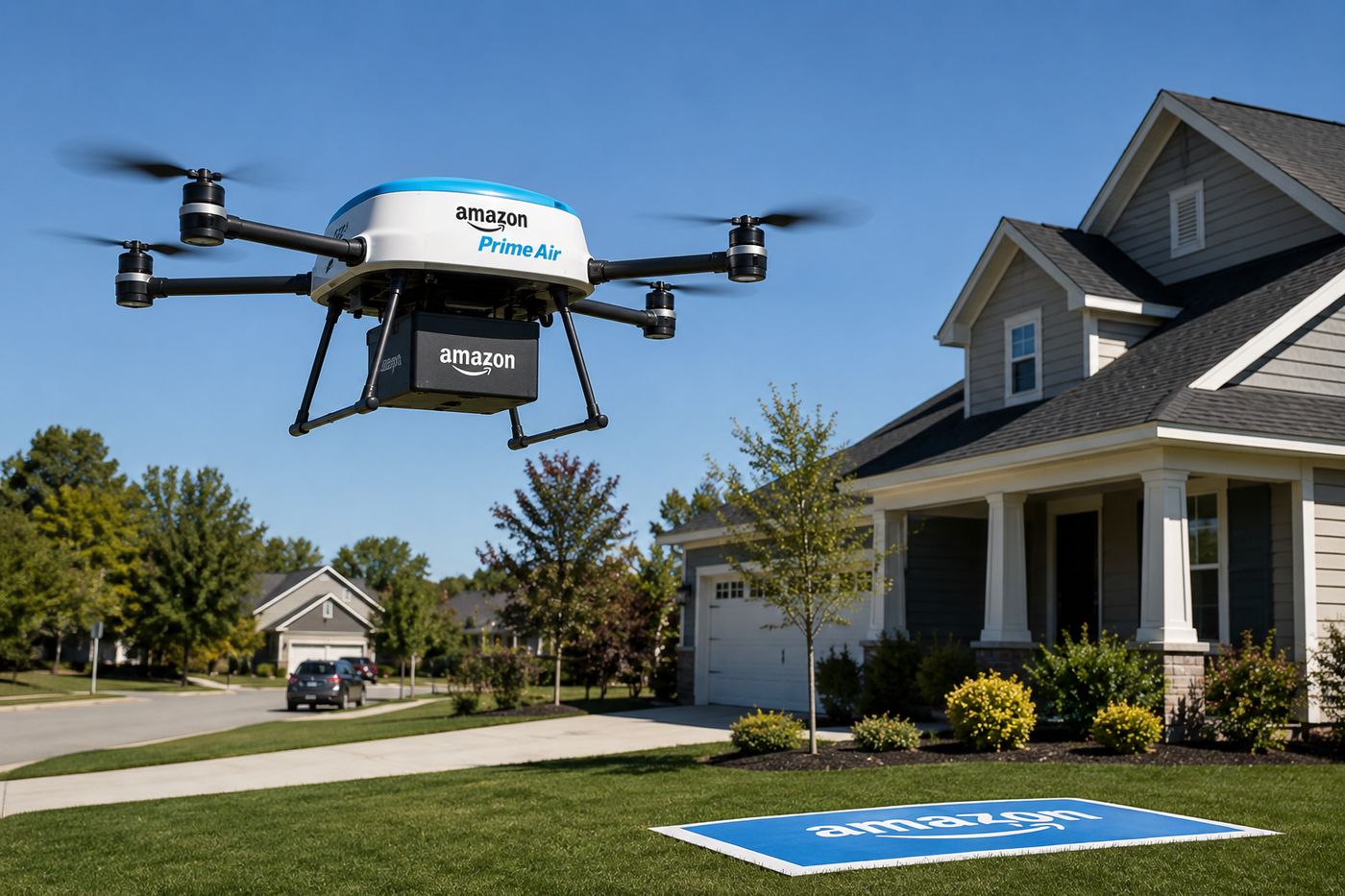
Amazon announced Wednesday that its Prime Air drone delivery service will expand to nearly 500 cities and towns across the United States by the end of 2026 — a sixfold increase from its current footprint of 11 delivery sites — bringing 30-minute drone delivery of groceries, medications, electronics, and household products to tens of millions of American customers before the year is out.
Prime Air currently operates across 10 metro areas in seven states — Arizona, Florida, Kansas, Louisiana, Michigan, Nebraska, and Texas — with each delivery site covering approximately 175 square miles. The expansion will initially add Chicago, Atlanta, Cleveland, Syracuse, and Boise to the network, with dozens of additional markets to follow throughout the remainder of the year. Eligible products are those weighing five pounds or less — a threshold Amazon says covers more than 60% of its most commonly ordered items. Drone delivery is free for Prime members on orders of $50 or more, $2.99 for Prime members on smaller orders, and $4.99 for non-members. Amazon said it has already completed hundreds of thousands of drone deliveries in 2026 and confirmed earlier internal projections of reaching one million drone deliveries by year-end are still on track.
"We've already delivered hundreds of thousands of packages to customers by drone this year, and by the end of 2026 we plan to reach customers in nearly 500 cities and towns. We're pairing the convenience of ultrafast drone delivery with the low prices and selection customers love about Amazon." — David Carbon, VP of Amazon Prime Air
The Prime Air expansion follows a key FAA regulatory milestone achieved earlier this year — approval for Beyond Visual Line of Sight operations, which allows Amazon's MK30 drones to fly without a human operator maintaining constant visual contact. The MK30 is equipped with an onboard Detect-and-Avoid system that continuously monitors surrounding airspace and makes real-time navigation decisions to avoid other aircraft, birds, and obstacles. Amazon operates Prime Air under FAA Part 135 certification — the same regulatory framework applied to commercial air carriers — a standard that distinguishes its operation from smaller, less regulated drone programs. The drones are rated for operation in light rain and a range of temperatures.
Amazon is not alone in the space. Google's Wing and Walmart-backed Zipline have been expanding drone delivery operations simultaneously, and Home Depot announced a nationwide express delivery program on Tuesday — a sign that the last-mile logistics race has entered a phase where speed is becoming a competitive necessity rather than a differentiator. The question industry analysts are watching is not whether drone delivery will scale, but how quickly the regulatory infrastructure, airspace management systems, and community acceptance will keep pace with the technology's capabilities.
Amazon's Prime Air program has been in development for more than a decade, first publicly announced in 2013. It faced years of regulatory delays, technical challenges, and two significant setbacks — the discontinuation of its original delivery drone program in 2022 and the grounding of its MK27 fleet in 2023. The current MK30 represents the third generation of the program's hardware and is purpose-built for scalable commercial delivery operations.
What Amazon is announcing is not science fiction — it is the logical endpoint of a decade of private sector investment in autonomous logistics, now scaled by regulatory approvals that the federal government has, to its credit, worked to accelerate. Thirty-minute drone delivery of medications to tens of millions of Americans — including those in suburban and rural areas who currently wait days for pharmaceutical shipments — is a genuine quality-of-life improvement produced by the same kind of American private sector ambition that has driven every logistics revolution in this country's history.