
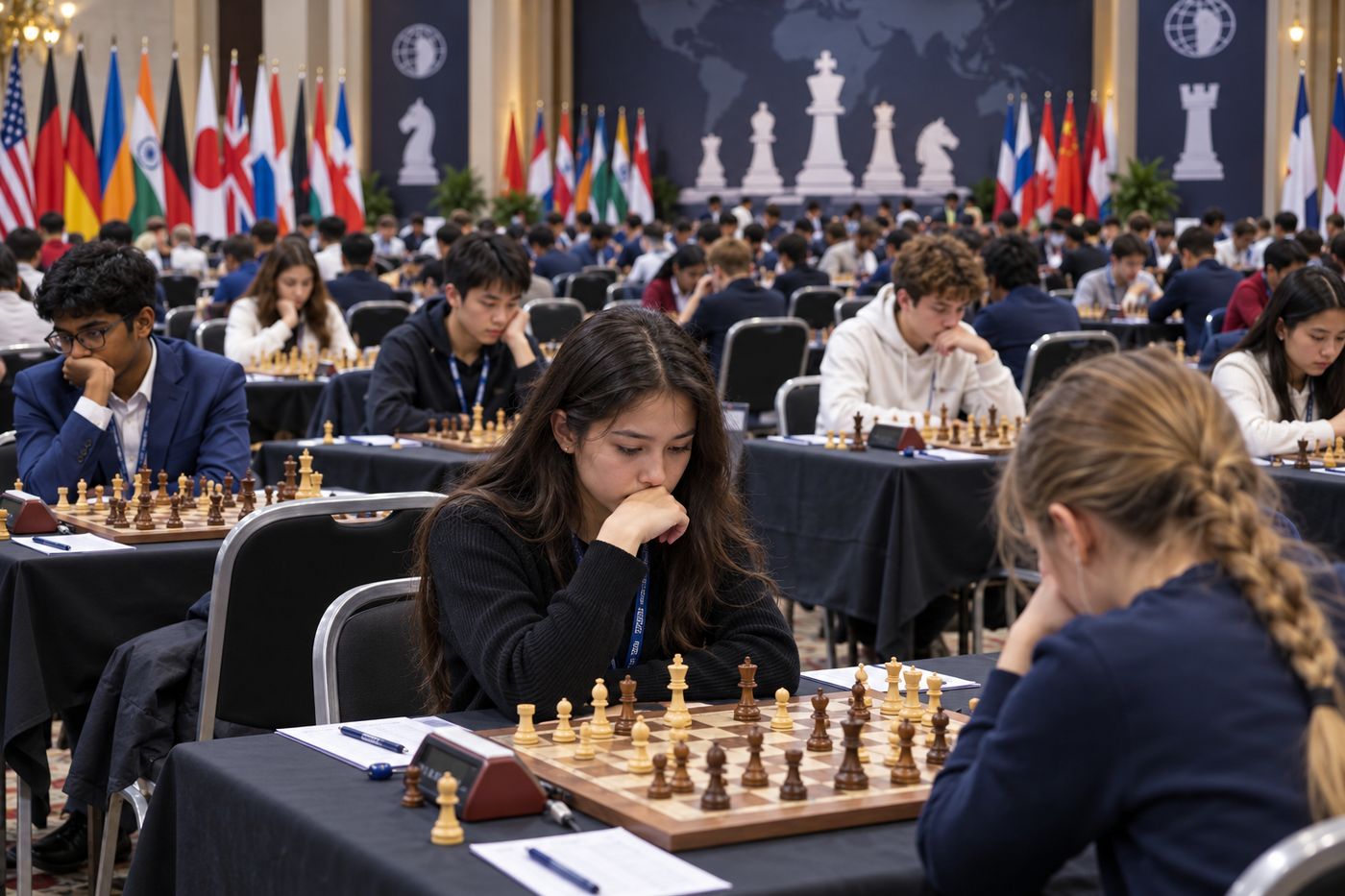
Bodhana Sivanandan — an 11-year-old London schoolgirl of Indian heritage who first encountered a chessboard when a departing family friend left one behind during COVID lockdown — has become the youngest Woman Grandmaster in the history of chess, securing the prestigious FIDE title at the 46th Chess Olympiad in Samarkand, Uzbekistan, after playing all 11 rounds on England's first board and finishing with eight points.
The Woman Grandmaster title is the highest female-only designation awarded by the International Chess Federation and is held for life. Bodhana secured her third and final qualifying norm — the performance standard required for the title — on September 27, the final day of the Olympiad, beating the previous age record set by Kateryna Lagno. She did not realize immediately that she had broken the record. "Now that you've told me, I'm happy," she told Lichess after being informed. "I'm happy to do it, but I want to keep going and keep making history as well, instead of just stopping here." Her trajectory over the past two years has been remarkable even by the standards of chess prodigies. At age ten in August 2025, she became the youngest female player to defeat a grandmaster, beating 60-year-old English grandmaster Peter Wells at the British Chess Championships in Liverpool. That same result gave her the final norm needed for the Woman International Master title — itself a record at the time. Last month, she became Britain's youngest-ever Women's Chess Champion at the 2026 British Chess Championships in Coventry.
"I'm happy to do it, but I want to keep going and keep making history as well, instead of just stopping here." — Bodhana Sivanandan, 11, after being informed she had become the youngest Woman Grandmaster in chess history
Bodhana's origin story is genuinely extraordinary. She was five years old — not nine, not eleven — when a family friend preparing to return to India gave away possessions including a chessboard. The little girl was fascinated by the knight and the queen, initially wanting to use the pieces as toys. Her father, Sivanandan Velayutham, who works in IT and knew only the basics of chess, explained the game and began showing her how the pieces moved. Neither parent was a competitive player. There was no systematic training plan, no chess academy, no structured program to develop a champion. Within a few years, the girl who learned the game almost by accident was defeating grandmasters who had been playing for decades longer than she had been alive. In July 2026, she became the youngest girl to defeat a grandmaster rated over 2600, beating French Grandmaster Marc'Andria Maurizzi at the Dole Open — surpassing a record previously held by legendary World Chess Champion Hou Yifan. By April 2026, at age eleven, she had become England's number-one ranked female player with a rating of 2,366.
At the Samarkand Olympiad she played on Board One — the position reserved for a team's strongest player — for all 11 rounds. The assignment itself speaks to how the English Chess Federation views her. Playing every round on top board at a World Olympiad as an 11-year-old would be remarkable for any junior player. Doing it while earning the final norm for a major title record is a different category of achievement. English Grandmaster David Howell, following her earlier victory over Ukrainian Grandmaster Mariya Muzychuk, described a Bodhana win as "an incredible result" — the kind of description that was applied to outlier victories and has since become a regular feature of her tournament results.
The Woman Grandmaster title requires three qualifying "norms" — performances meeting a specific rating threshold against sufficiently strong opposition — along with achieving a FIDE rating of at least 2300. Bodhana earned her first WGM norm at age 10 in July 2025, making her the youngest ever to do so at that point, surpassing Hou Yifan's record from 2005. She currently juggles competitive chess at the international elite level with full-time attendance at school in northwest London. She is also the UK Open Women's Blitz Champion and joint British Women's Rapid Champion.
At eleven years old, Bodhana Sivanandan has defeated grandmasters in their 50s and 60s, broken records set by players who held them for decades, and claimed a title that chess history will attach to her name forever. She learned the game from a chessboard left behind by a departing family friend, from a father who knew only the basics, with no formal plan and no structured development program — which is either the most inspiring origin story in modern chess or an argument that the prerequisites for greatness are considerably less predictable than any coaching system would suggest. She says she wants to keep making history. Given what she has already done, there is no sensible reason to doubt her.